
Loading
 ← Back to blogs
Learn what SEM is, how Search Engine Marketing works, its benefits, Google Ads basics, and why SEM is essential for driving traffic and generating leads online.
In today's competitive digital landscape, businesses need fast and effective ways to reach potential customers online. While Search Engine Optimization (SEO) focuses on earning organic traffic over time, SEM (Search Engine Marketing) helps businesses gain immediate visibility on search engines through paid advertising.
Whether you're a student, business owner, or aspiring digital marketer, understanding SEM is an essential skill. It enables businesses to display ads to people who are actively searching for products or services, making it one of the most effective digital marketing strategies for generating qualified leads and increasing sales.
In this beginner-friendly guide, you'll learn what SEM is, how it works, its benefits, key components, and why it's important for businesses in 2026.
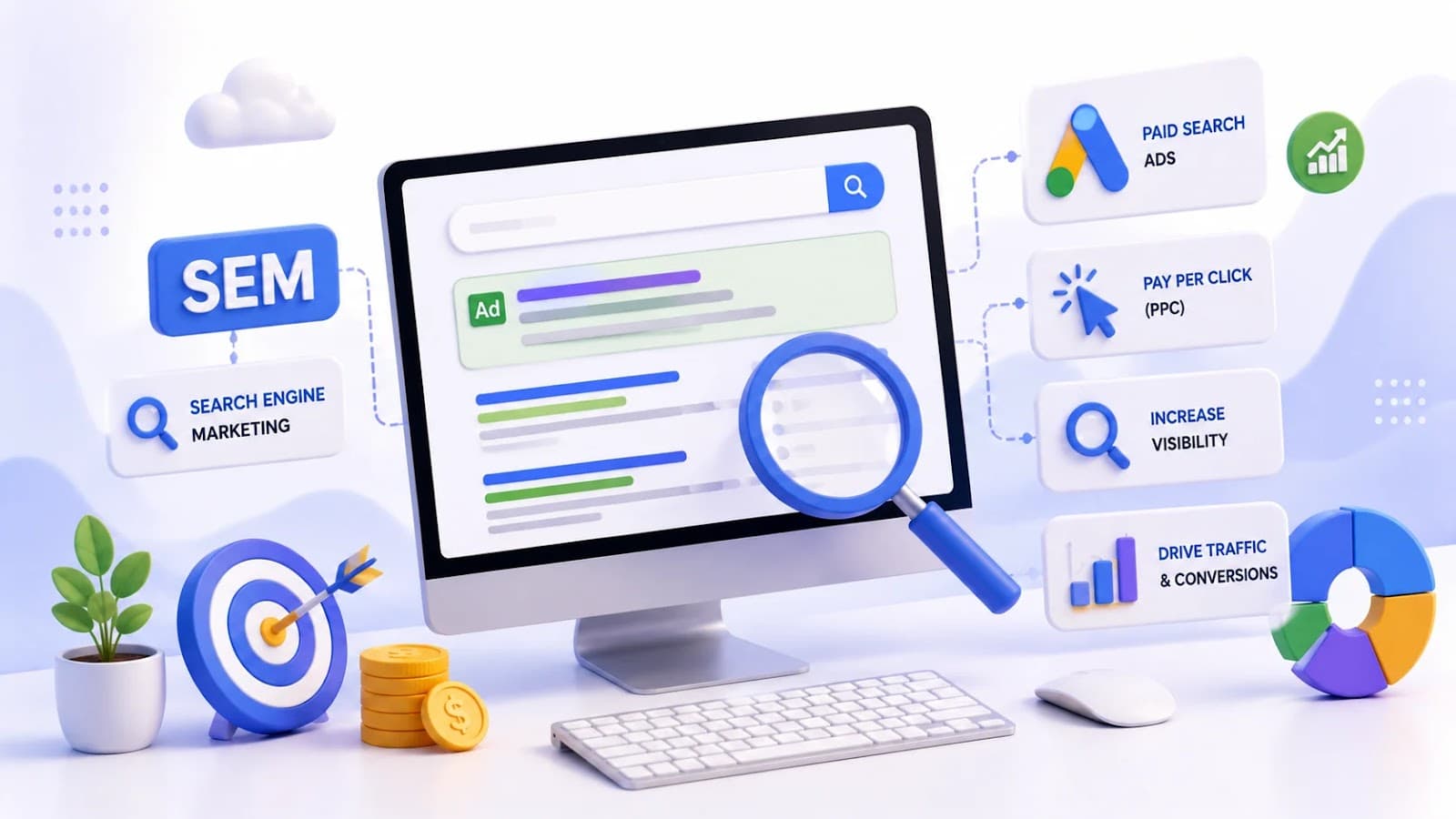
SEM (Search Engine Marketing) is a digital marketing strategy that uses paid advertisements to increase a website's visibility on search engines like Google and Bing.
Instead of waiting for organic rankings through SEO, businesses can pay to display their ads at the top of search engine results pages (SERPs).
For example, when someone searches for:
Sponsored ads often appear before the organic search results. These ads are created using search engine advertising platforms like Google Ads.
SEM works on a bidding system where advertisers bid on specific keywords that users search for.
Here's how the process works:
This model ensures businesses pay for actual engagement rather than just displaying advertisements.
SEM provides businesses with instant visibility and helps them connect with customers who are already interested in their products or services.
Some key benefits include:
For businesses looking for quick results, SEM is one of the most effective marketing strategies.
Although SEO and SEM both improve search engine visibility, they work differently.
SEO | SEM |
Generates organic traffic | Generates paid traffic |
Takes time to see results | Delivers immediate visibility |
No payment for clicks | Pay only when users click ads |
Focuses on website optimization | Focuses on paid advertising campaigns |
Long-term strategy | Short-term and scalable strategy |
Many businesses combine both SEO and SEM for the best results.
Successful SEM campaigns include several important elements.
Keywords are the search terms people type into search engines.
Examples include:
Choosing the right keywords helps reach the right audience.
An effective advertisement includes:
Good ad copy increases click-through rates (CTR).
After clicking an ad, users should arrive on a relevant landing page.
A good landing page should:
A high-quality landing page improves conversion rates.
SEM allows advertisers to control spending.
Businesses can:
This flexibility makes SEM suitable for businesses of all sizes.
Google Ads provides detailed analytics, including:
These insights help marketers improve campaign performance.
Google Ads offers different campaign types depending on business goals.
Text-based advertisements displayed on Google Search results.
Best for:
Visual banner ads shown across websites in Google's Display Network.
Best for:
Product listings that display images, prices, and store details.
Ideal for:
Advertisements shown on YouTube before or during videos.
Great for:
AI-powered campaigns that run across multiple Google platforms, including Search, YouTube, Gmail, Display, and Maps.
Ideal for businesses looking to maximize conversions using Google's automation.
SEM provides several advantages for businesses.
Unlike SEO, SEM can start generating traffic immediately after a campaign launches.
Businesses can target audiences based on:
Every click, impression, and conversion can be tracked using analytics.
Businesses can advertise with small or large budgets depending on their goals.
Users searching for products or services often have strong purchase intent, increasing the chances of conversion.
To run successful SEM campaigns:
Continuous optimization leads to better campaign performance.
Beginners should avoid these mistakes:
Avoiding these mistakes helps improve ROI.
If you want to become an SEM specialist, develop these skills:
These skills are highly valued by employers and agencies.
SEM professionals are in demand across many industries.
Popular job roles include:
Many SEM professionals also work as freelancers or consultants.
Search engine advertising continues to evolve with technology.
Emerging trends include:
Professionals who stay updated with Google's latest advertising features will remain highly competitive.
SEM stands for Search Engine Marketing, a digital marketing strategy that uses paid advertisements to increase visibility on search engines.
Google Ads is the most popular platform used to run SEM campaigns, but SEM also includes advertising on other search engines like Bing.
SEO focuses on improving organic search rankings, while SEM uses paid advertising to appear at the top of search results immediately.
Yes. Beginners can learn SEM by understanding Google Ads, keyword research, bidding strategies, and campaign optimization.
Absolutely. SEM allows businesses to start with a small budget and scale campaigns as they grow.
SEM is one of the fastest ways for businesses to increase online visibility, generate qualified leads, and drive sales. Unlike organic marketing methods that take time, SEM provides immediate exposure by placing your ads in front of users who are actively searching for your products or services.
Whether you're a student exploring digital marketing, a business owner looking to attract more customers, or someone planning a career in paid advertising, learning SEM is a valuable investment. By understanding keyword research, Google Ads, campaign optimization, and performance tracking, you can build effective advertising campaigns that deliver measurable results and contribute to long-term business growth.
Learn what Digital Marketing is, its types, benefits, career opportunities, AI trends, and why it's one of the most in-demand skills for students and professionals in 2026.
Discover the benefits of learning Digital Marketing after college, explore career opportunities, essential skills, freelancing, and how to build a successful Digital Marketing Career.
Explore the top 10 Digital Marketing Skills every student should master, from SEO and Google Ads to AI tools, to build a successful Marketing Skills portfolio and career.