
Loading
 ← Back to blogs
Learn prompt engineering from the basics. Discover prompt types, practical examples, useful techniques, templates, and tips for getting better AI results.
Artificial Intelligence tools such as ChatGPT, Google Gemini, and Claude can help with writing, research, coding, marketing, education, and many other tasks. However, the quality of the response often depends on how you communicate with the AI.
This is where prompt engineering becomes useful.
Prompt engineering is the process of creating clear and effective instructions for AI systems so they can produce more relevant, useful, and accurate responses.
You don't need to be a programmer to learn prompt engineering. Students, marketers, content creators, designers, developers, teachers, and business owners can all benefit from learning how to write better prompts.
In this guide, you'll learn what prompt engineering is, how prompts work, important prompt components, practical techniques, examples, common mistakes, and how to improve your AI conversations.
Prompt engineering is the practice of designing and refining instructions given to an AI model to achieve a desired result.
A prompt can be as simple as:
Explain SEO.
Or more detailed:
Explain SEO to a college student who has never studied digital marketing. Use simple English, practical examples, and a step-by-step structure.
The second prompt provides more context, which can help produce a more useful response.
Good prompts can help you:
Learning prompt engineering is therefore becoming a useful skill for anyone who regularly works with AI tools.
A prompt is the instruction, question, context, or information you provide to an AI system.
Examples include:
Write an Instagram caption for a digital marketing course.
Explain Google Ads in simple English.
Create a study plan for my exam.
Review this paragraph for grammar mistakes.
Generate five blog ideas about SEO.
The prompt tells the AI what you want it to do.
Write a blog about SEO.
This gives the AI very little information.
Write a beginner-friendly blog about SEO for college students. Use simple English, short paragraphs, practical examples, H2 and H3 headings, FAQs, and a conclusion. Focus on helping readers understand the fundamentals of SEO.
The second prompt provides:
This makes the desired output much clearer.
A useful prompt can include several components.
Tell the AI what role it should take.
Example:
Act as an experienced digital marketing trainer.
Clearly explain what you want.
Example:
Create a beginner-friendly lesson about Google Ads.
Provide relevant background information.
Example:
The audience consists of college students with no previous digital marketing experience.
Specify who will consume the output.
Examples:
Tell the AI how the response should sound.
Examples:
Specify how you want the response structured.
Examples:
Define limitations or requirements.
Example:
Keep the explanation under 1,000 words and use simple English.
A simple formula beginners can use is:
Role + Task + Context + Audience + Format + Constraints
For example:
Act as a digital marketing trainer. Create a beginner-friendly explanation of Google Ads. The audience is college students with no advertising experience. Use simple English, practical examples, headings, and a short quiz at the end. Keep the lesson under 1,500 words.
This structure gives the AI clear instructions.
Zero-shot prompting means asking the AI to perform a task without providing examples.
Example:
Write five Instagram captions for a digital marketing academy.
You simply describe the task and let the AI generate the response.
This approach works well for straightforward tasks.
Few-shot prompting provides examples so the AI can understand the desired pattern.
Example:
Create social media captions in this style:
Example 1: Learn today. Grow tomorrow.
Example 2: Build skills. Build your career.
Now create five captions for a digital marketing course using a similar style.
Examples can help the AI understand your preferred format and tone.
Role prompting gives the AI a specific professional perspective.
Example:
Act as an SEO specialist with experience in educational websites.
Then provide your task.
Role prompting can be useful when you want the response to follow a particular professional perspective.
For complex tasks, asking the AI to work through a problem step by step can sometimes improve the usefulness of the answer.
For example:
Break this marketing problem into smaller steps and explain the solution clearly.
For educational purposes, you can ask for a concise explanation of the reasoning or methodology rather than relying only on the final answer.
Prompt engineering is an iterative process.
After receiving an answer, you can ask:
Make this explanation simpler.
Or:
Add practical examples.
Or:
Rewrite this for college students.
Or:
Make the tone more professional.
You don't always need to create a completely new prompt.
A useful workflow is:
Prompt → Review → Refine → Improve → Final Output
For example:
Write a blog introduction about SEO.
Make the introduction more engaging.
Rewrite it for beginners using simpler English.
Add a practical example.
This process can produce better results than trying to create one perfect prompt immediately.
Content creators can use prompts for:
Example:
Create 20 blog ideas for a digital marketing academy. Target college students and beginners. Focus on educational topics related to SEO, Google Ads, Meta Ads, AI, and content marketing.
AI can help with SEO tasks such as:
Example:
Create an SEO content outline for "Keyword Research for Beginners." Target students and new digital marketers. Include H2 and H3 headings, practical examples, FAQs, and a conclusion.
AI suggestions should still be validated using actual search data and SEO tools.
Marketers can create prompts for:
Example:
Create a 30-day social media content plan for a digital marketing academy targeting college students. Include content topics, formats, objectives, and CTA ideas.
Students can use prompts to:
Example:
Explain photosynthesis to a Class 10 student using a simple real-world example.
Developers can use prompts to:
Example:
Explain this JavaScript function line by line. Assume I am a beginner and explain any unfamiliar concepts.
When using AI-generated code, always test and review it before using it in a real project.
Image-generation prompts can describe:
Example:
Create a realistic photograph of a modern digital marketing classroom with students working on laptops, natural lighting, professional educational environment, wide composition.
Detailed visual instructions can help communicate the desired result more clearly.
Business owners can use AI prompts for:
Example:
Create a marketing plan for a local digital marketing training academy targeting college students. Include customer segments, marketing channels, content ideas, lead-generation methods, and KPIs.
Follow these principles:
Instead of:
Write about Google Ads.
Try:
Explain Google Ads to a beginner in simple English with practical examples.
Tell the AI why you need the output.
I am creating a beginner-level lesson for college students.
Tell the AI what you expect.
Present the answer using headings, bullet points, examples, and a summary.
Example:
Keep each explanation under 100 words.
If you have a preferred style, show the AI an example.
Poor:
Create content.
Better:
Write a 500-word Instagram caption about the benefits of learning digital marketing for college students.
Conflicting instructions can make the desired output unclear.
Keep requirements organized and consistent.
Without context, the AI may make assumptions.
Provide relevant information about:
AI output often improves through refinement.
Use follow-up prompts to correct and improve the response.
AI can produce incorrect or misleading information.
Always review important content before using it.
Before submitting a prompt, ask:
✔ Did I clearly explain the task?
✔ Did I provide enough context?
✔ Did I identify the audience?
✔ Did I specify the desired format?
✔ Did I explain the tone?
✔ Did I include important constraints?
✔ Did I provide examples when necessary?
✔ Did I explain the expected outcome?
✔ Am I prepared to refine the response?
You can use this template for many AI tasks:
Role: Act as a [role].
Task: [Clearly explain what you want].
Context: [Provide relevant background].
Audience: [Describe the target audience].
Tone: [Professional/Friendly/Educational/etc.].
Format: [Table/Bullets/Article/Steps/etc.].
Constraints: [Word count, language, requirements].
Goal: [Explain the desired outcome].
This simple framework can be adapted for ChatGPT, Claude, Google Gemini, and other AI tools.
Prompt engineering is the process of creating and refining instructions to help AI systems produce more useful and relevant responses.
No. Basic prompt engineering does not require programming knowledge. Anyone who can clearly communicate instructions can learn the fundamentals.
No. Students, marketers, teachers, business owners, designers, writers, and developers can all benefit from prompt engineering.
Be specific, provide context, define the desired output, set clear constraints, provide examples when useful, and refine your prompts based on the AI's response.
Not always. Different AI tools may have different capabilities and strengths. A prompt may need to be adjusted depending on the tool and task.
Prompt engineering is an important skill for anyone who wants to use AI effectively. The goal isn't to create complicated prompts—it is to communicate your requirements clearly.
A strong prompt provides the AI with enough information about the task, context, audience, format, and expected result. When the first response isn't perfect, refine the prompt and continue the conversation.
Whether you're a student using AI for learning, a marketer creating campaigns, or a content creator producing articles, learning prompt engineering can help you get more useful results while saving time and improving productivity.
The best AI users don't simply ask better questions—they learn how to communicate clearly with AI and critically evaluate the answers they receive.

Learn what Digital Marketing is, its types, benefits, career opportunities, AI trends, and why it's one of the most in-demand skills for students and professionals in 2026.

Discover the benefits of learning Digital Marketing after college, explore career opportunities, essential skills, freelancing, and how to build a successful Digital Marketing Career.
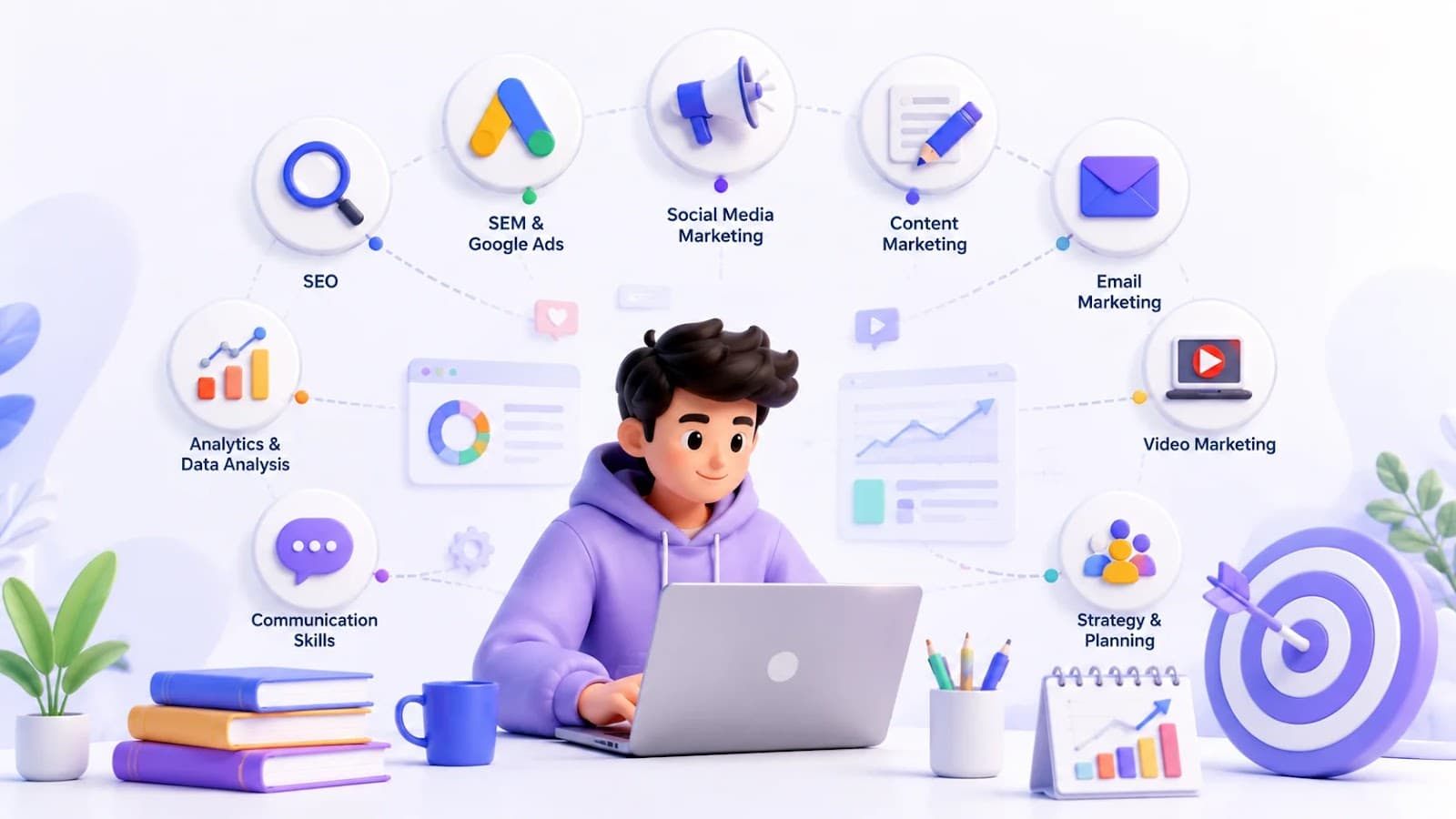
Explore the top 10 Digital Marketing Skills every student should master, from SEO and Google Ads to AI tools, to build a successful Marketing Skills portfolio and career.