
Loading
 ← Back to blogs
Learn how landing page optimization improves user experience, builds trust, and increases conversions with practical design, content, and CTA strategies.
Driving traffic to your website is only the first step in digital marketing. The real challenge is turning those visitors into leads, enquiries, subscribers, or customers.
Many businesses invest in SEO, Google Ads, social media campaigns, and email marketing to attract potential customers. However, if the landing page fails to communicate the offer clearly or makes it difficult for visitors to take action, valuable opportunities can be lost.
This is where landing page optimization becomes important.
Landing page optimization is the process of improving a page's content, design, user experience, and calls to action to encourage visitors to complete a specific goal. A well-optimized landing page helps visitors understand the offer, evaluate its value, and decide what to do next.
In this guide, you'll learn how landing page optimization works, which elements influence conversions, common mistakes to avoid, and practical strategies to improve landing page performance.
Landing page optimization is the process of improving a webpage to increase the percentage of visitors who complete a desired action.
A landing page is usually designed around a specific marketing objective. Unlike a general website page that may contain several navigation options and topics, a focused landing page guides visitors toward one primary goal.
Depending on the business, this goal could be:
For example, a digital marketing academy running a Google Ads campaign for a professional course might direct visitors to a dedicated course landing page. The page could explain the curriculum, learning format, practical projects, and available support before inviting visitors to enquire or register.
The purpose of optimization is to make this journey clearer and more effective.
Website optimization focuses on improving the overall performance of a website, including its speed, navigation, technical SEO, accessibility, and usability.
Landing page optimization focuses on improving a specific page's ability to achieve a defined conversion goal.
Both are important. A landing page must provide a good user experience, but its content and design should also support the action the business wants visitors to take.
A landing page connects your marketing campaign with the action you want a visitor to complete. Improving this connection can support better marketing performance.
Getting visitors to your website does not automatically generate enquiries.
A landing page that explains the offer, answers relevant questions, and presents a clear next step can make it easier for interested visitors to submit their details.
Visitors should not have to search through multiple sections to understand what is being offered.
Clear headings, readable content, intuitive forms, and mobile-friendly layouts reduce unnecessary friction and help visitors make informed decisions.
Businesses running Google Ads or Meta Ads can direct campaign traffic to a page designed specifically for the advertised offer.
When the ad message, landing page content, and visitor expectations align, the experience becomes more consistent. This can support better conversion performance, although results depend on several factors beyond the page itself.
Visitors may hesitate if they cannot verify a business's credibility or understand what happens after submitting a form.
Relevant testimonials, transparent pricing where appropriate, clear contact details, and accurate information can help address these concerns.
Landing page analytics can reveal where visitors lose interest, which traffic sources produce valuable leads, and which page elements need improvement.
These insights allow businesses to make evidence-based decisions rather than relying only on assumptions.
A landing page conversion rate is the percentage of visitors who complete a defined conversion action.
The calculation is:
Conversion rate = (Number of conversions ÷ Number of visitors) × 100
For example, if a landing page receives 1,000 visitors and 50 visitors submit an enquiry form, the conversion rate is 5%, assuming visitors are the chosen denominator.
Different analytics systems may calculate conversion rates using sessions, users, or another defined measurement. Use a consistent definition when comparing performance.
There is no single conversion rate that is ideal for every landing page.
Performance varies according to the industry, offer, traffic source, audience, device, conversion goal, and buying process.
Instead of comparing your page with an arbitrary benchmark, establish your current performance and work toward measurable improvements.
For example, a page designed to generate qualified business enquiries may have a different conversion pattern from an online store's product page.
An effective landing page combines clear messaging, useful information, trust signals, and a straightforward conversion process.
Your headline is often the first element visitors notice.
It should communicate what you offer and why it is relevant to the target audience. Avoid vague headlines that sound attractive but do not explain the actual value.
For example:
Weak headline: "Take Your Future to the Next Level"
More specific headline: "Build Practical Digital Marketing Skills With Industry-Focused Training"
The stronger example explains the subject and intended benefit more clearly.
Use the introductory text to explain the offer in greater detail.
Highlight the most important benefits, clarify who the offer is for, and help visitors understand what makes it relevant to their needs.
Keep the information concise enough for visitors to scan easily.
A call to action tells visitors what to do next.
Examples include:
Choose a CTA that matches the offer and the visitor's stage in the decision-making process.
Make the button visually distinct, use clear wording, and ensure that clicking it leads to the expected next step.
Visitors want to know how an offer addresses their needs.
Instead of listing features without explanation, show why those features matter.
For example, rather than simply stating that a course includes practical projects, explain that practical projects allow learners to apply concepts and develop work samples.
Use specific, accurate benefits rather than unsupported promises.
Visitors may need reassurance before sharing their information or making a purchase.
Depending on the offer, useful trust signals include:
Use authentic evidence and obtain appropriate permission before publishing customer testimonials or identifiable information.
Long or confusing forms can discourage visitors from completing an enquiry.
Ask only for information needed at that stage of the customer journey.
For example, a basic course enquiry form might request a name, email address, and phone number if those details are genuinely required.
Explain how the information will be used and provide a clear privacy notice where appropriate.
Many visitors reach landing pages through mobile devices.
Your page should adapt to different screen sizes, use readable text, provide comfortable spacing, and make buttons easy to tap.
Check that forms work correctly on mobile and that important content is not hidden behind unnecessary elements.
Slow pages can interrupt the visitor journey before the offer is even understood.
Optimize image sizes, reduce unnecessary scripts, review third-party integrations, and use suitable caching and hosting configurations.
Measure real performance rather than assuming a page is fast because it loads quickly on your own device.
Images should support the offer rather than distract from it.
Use product images, course visuals, demonstrations, or other relevant graphics that help visitors understand what they are considering.
Optimize images for file size and display dimensions. Provide descriptive alternative text for meaningful images and appropriate empty alt attributes for decorative images.
When visitors click an advertisement, they expect the destination page to match the message that attracted them.
If an ad promotes a particular service or course, the landing page should clearly feature that same offer.
Consistent messaging helps visitors confirm that they have reached the right destination.
A structured process helps businesses improve landing pages without changing multiple elements blindly.
Start by deciding what the page should achieve.
Is the goal to generate leads, collect registrations, sell a product, or encourage visitors to book a consultation?
Choose a primary conversion goal and define how it will be measured.
Secondary actions can be tracked where useful, but they should not distract from the page's main objective.
Research the audience's needs, challenges, questions, and decision-making factors.
Review customer enquiries, feedback, search queries, and relevant analytics data.
Use this information to understand what visitors need to know before they feel comfortable taking action.
Evaluate the page from the visitor's perspective.
Check whether the headline explains the offer, whether the CTA is easy to find, whether the content answers common questions, and whether the form works correctly.
Also review mobile usability, loading speed, accessibility, and any technical issues that may prevent conversions.
Make the main message specific and relevant to the target audience.
Use concise paragraphs, descriptive subheadings, and benefit-focused explanations.
Remove unnecessary repetition and replace vague claims with clear, verifiable information.
Review the button wording, placement, contrast, and destination.
Make sure the form requests only necessary information and provides useful feedback when fields are completed incorrectly.
Test the complete conversion journey, including the confirmation message or thank-you page.
Remove elements that compete with the main conversion goal when they do not provide meaningful value.
Depending on the page, this may involve simplifying navigation, reducing intrusive pop-ups, or moving secondary links away from the primary CTA.
Do not remove information that visitors need to make an informed decision.
Test the page on mobile and desktop devices.
Review image sizes, layout shifts, button spacing, font readability, and form usability. Use performance diagnostics to identify issues that may affect loading and interaction.
A/B testing compares two versions of a page or element to understand which performs better under comparable conditions.
For example, you could test two different headlines while keeping the rest of the page consistent.
Define the primary metric before the test, ensure tracking works, and gather enough data to draw a reasonable conclusion. Avoid declaring a winner based on a small or misleading sample.
Review conversion rates alongside traffic quality, lead quality, and business outcomes.
A page that produces many enquiries may not be effective if most enquiries are irrelevant. Consider both the quantity and quality of conversions.
Use the results to prioritize the next improvement.
Follow these practices to create a clearer and more effective conversion experience.
If visitors arrive from a search query, make sure the page addresses the need behind that query.
For example, a person searching for a specific service should find relevant service information rather than a generic company introduction.
Arrange the headline, supporting copy, key benefits, proof points, and CTA in a logical order.
Visitors should be able to understand the main message without having to read every word.
Explain what visitors receive, who the offer is intended for, and what happens after they respond.
Avoid unnecessary jargon or ambiguous claims.
A primary CTA can appear near the top of the page and again after important supporting information on a longer page.
Each placement should feel natural and support the same primary goal.
Support claims with accurate information, genuine reviews, relevant results, or clear explanations of the service.
Avoid fabricated testimonials, guaranteed outcomes, and misleading urgency messages.
Use sufficient color contrast, readable text, descriptive labels, keyboard-accessible controls, and clear error messages.
Accessible design helps more visitors understand and use the page.
Measure the actions that matter, from the initial visit to form completion and, where possible, qualified leads or sales.
Ensure that tracking respects applicable privacy requirements and that the collected data is reliable.
If visitors cannot quickly understand the offer, they may leave before exploring the page.
Make the headline specific and relevant.
Several equally prominent actions can create confusion.
Choose one primary conversion goal and present secondary actions with an appropriate visual hierarchy.
Forms that request unnecessary details can introduce friction.
Collect only what is needed for the immediate purpose and gather additional information later when appropriate.
A page that looks attractive on a desktop may be difficult to use on a phone.
Test real layouts and interactions across common screen sizes.
Promises such as guaranteed results can damage trust if they cannot be substantiated.
Use transparent, accurate descriptions of your offer.
Without reliable tracking, it is difficult to determine whether changes are helping.
Set up conversion events and test them before evaluating performance.
If several major elements change simultaneously, it can be difficult to understand which change affected performance.
Where possible, test specific hypotheses and make controlled comparisons.
A high number of form submissions does not automatically mean a campaign is successful.
Review lead quality, sales outcomes, and the value of the conversions generated.
Use a consistent measurement framework to evaluate your landing page.
Measures the percentage of visitors or sessions that complete the defined goal.
Compare results over time and segment them by relevant factors such as traffic source or device.
Review the engagement metrics available in your analytics platform to understand whether visitors interact with the page.
Interpret these metrics in context. A visitor may complete a single-page action successfully without viewing another page.
Compare form starts with successful submissions when both events are tracked reliably.
A large gap may indicate confusing fields, technical errors, or other friction.
For paid campaigns, calculate how much it costs to generate a lead.
Consider lead quality as well as the raw cost, because inexpensive leads may not necessarily be valuable leads.
Where data is available, measure how many generated leads eventually become customers.
This connects landing page activity with business outcomes.
Monitor loading speed, interaction responsiveness, mobile usability, and technical errors.
Use tools such as Google PageSpeed Insights to identify performance opportunities.
The right tools depend on your website platform, budget, and measurement requirements.
Useful for measuring landing page traffic, user interactions, and configured conversion events.
Useful for understanding search impressions, clicks, and queries that bring visitors from Google Search.
Useful for reviewing page performance and identifying technical improvements.
Tools in this category can help teams understand how visitors interact with page elements, subject to suitable privacy controls and consent requirements.
Testing tools can help compare page variations and evaluate whether a change improves the chosen conversion metric.
Select tools that integrate with your website and support reliable measurement. More tools do not automatically produce better results; a well-defined measurement plan is essential.
Landing page optimization is the process of improving a page's content, design, usability, and conversion journey to increase the percentage of visitors who complete a desired action.
Start by clarifying the headline, improving the offer's messaging, making the CTA prominent, simplifying forms, improving mobile usability, and checking page speed. Measure performance to determine which changes help.
There is no universal benchmark. A good rate depends on the offer, industry, traffic source, audience, and conversion goal. Compare your results with a relevant baseline and focus on measurable improvement.
Slow loading can create friction and cause visitors to abandon a page before engaging with its content. Improving performance can make the experience smoother, although conversion outcomes also depend on the offer and audience.
A landing page should generally have one clear primary conversion goal. The primary CTA may appear in multiple relevant locations, while secondary actions should not compete unnecessarily for attention.
Landing page optimization can support SEO by improving usability, content relevance, and page experience. However, conversion optimization alone does not guarantee higher search rankings. Search intent, technical accessibility, content quality, and other ranking factors also matter.
A/B testing compares two versions of a page or element to determine which performs better against a predefined metric. Reliable results require appropriate tracking, comparable conditions, and sufficient data.
Google Analytics 4, Google Search Console, PageSpeed Insights, heatmap tools, and A/B testing platforms can help measure and improve different aspects of landing page performance.
Review performance regularly and make changes when data, customer feedback, technical issues, or changes to the offer indicate an opportunity. There is no fixed schedule suitable for every business.
A homepage usually introduces a business and provides several navigation options. A landing page is typically designed around a specific campaign, offer, or conversion goal.
Landing page optimization helps businesses create a smoother journey between attracting visitors and encouraging them to take action.
By improving headlines, clarifying benefits, simplifying forms, strengthening CTAs, enhancing mobile usability, and measuring performance, businesses can identify opportunities to improve their conversion results.
Start by defining one clear goal, understanding your audience, and reviewing your current page performance. Test meaningful changes, evaluate lead quality, and continue improving based on reliable data.
Remember, an effective landing page is not simply about getting more clicks. It is about helping the right visitors understand your offer and take the next appropriate step.
Successful digital marketing requires more than attracting traffic. Understanding SEO, landing page design, analytics, and conversion optimization helps you connect marketing activities with meaningful business outcomes.
Explore digital marketing learning resources from Hirloye Academy and build your knowledge of practical marketing strategies.
Visit the Hirloye Academy blog to explore more digital marketing guides and resources.

Learn what Digital Marketing is, its types, benefits, career opportunities, AI trends, and why it's one of the most in-demand skills for students and professionals in 2026.

Discover the benefits of learning Digital Marketing after college, explore career opportunities, essential skills, freelancing, and how to build a successful Digital Marketing Career.
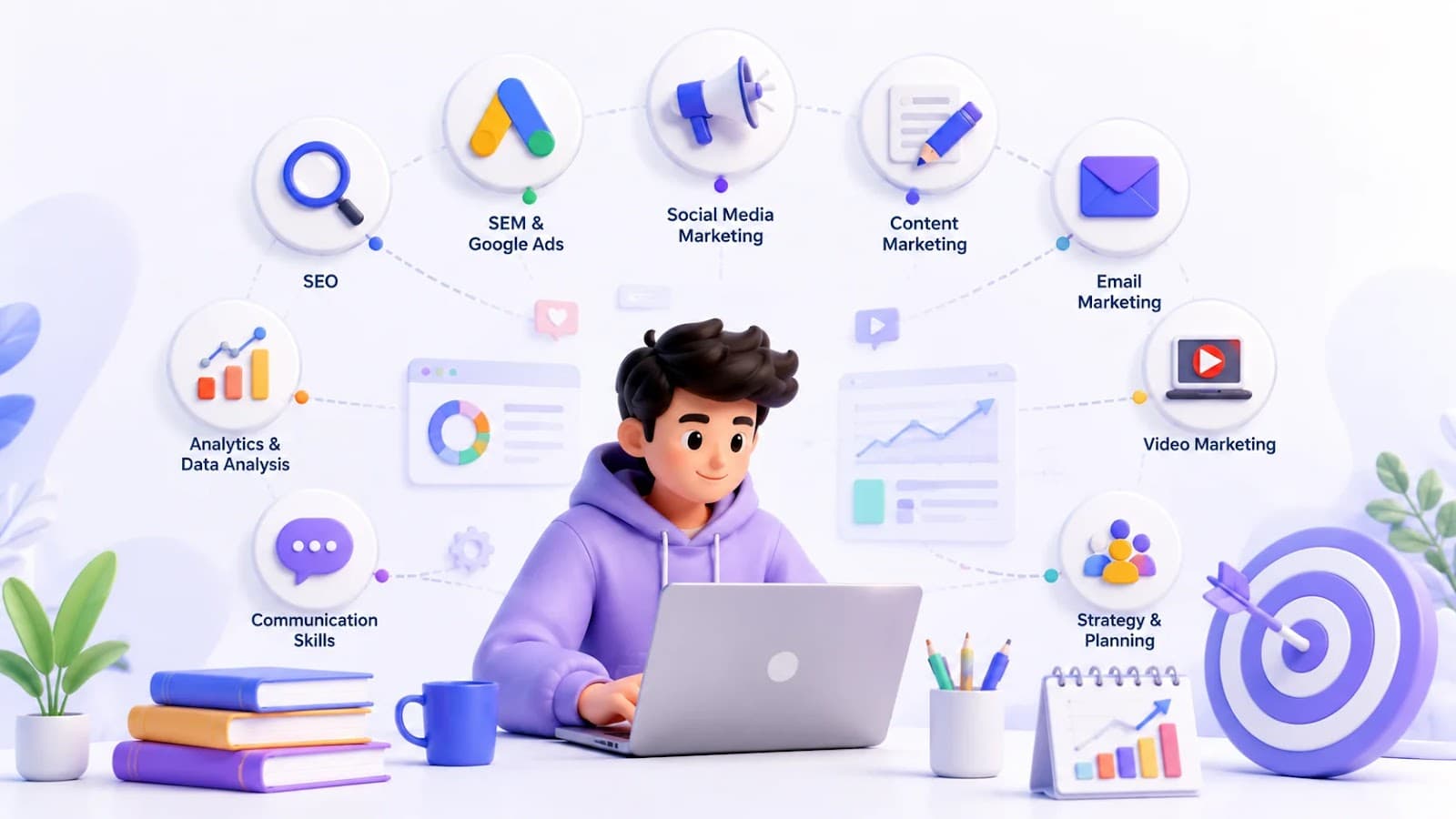
Explore the top 10 Digital Marketing Skills every student should master, from SEO and Google Ads to AI tools, to build a successful Marketing Skills portfolio and career.