
Loading
 ← Back to blogs
Learn what Google Ads Quality Score is, how it works, the factors that influence it, and proven strategies to improve ad performance and reduce costs.
When running Google Ads campaigns, many beginners focus only on increasing their budget or bidding higher for keywords. However, one of the most important factors that determines the success of your campaigns is Quality Score.
Quality Score is Google's way of measuring how relevant and useful your advertisements are to users. A higher Quality Score can help your ads appear in better positions while reducing your advertising costs.
Understanding Quality Score is essential if you want to improve your Google Ads performance and maximize your return on investment.
In this guide, you'll learn what Quality Score is, how it works, the factors that influence it, and practical ways to improve it.
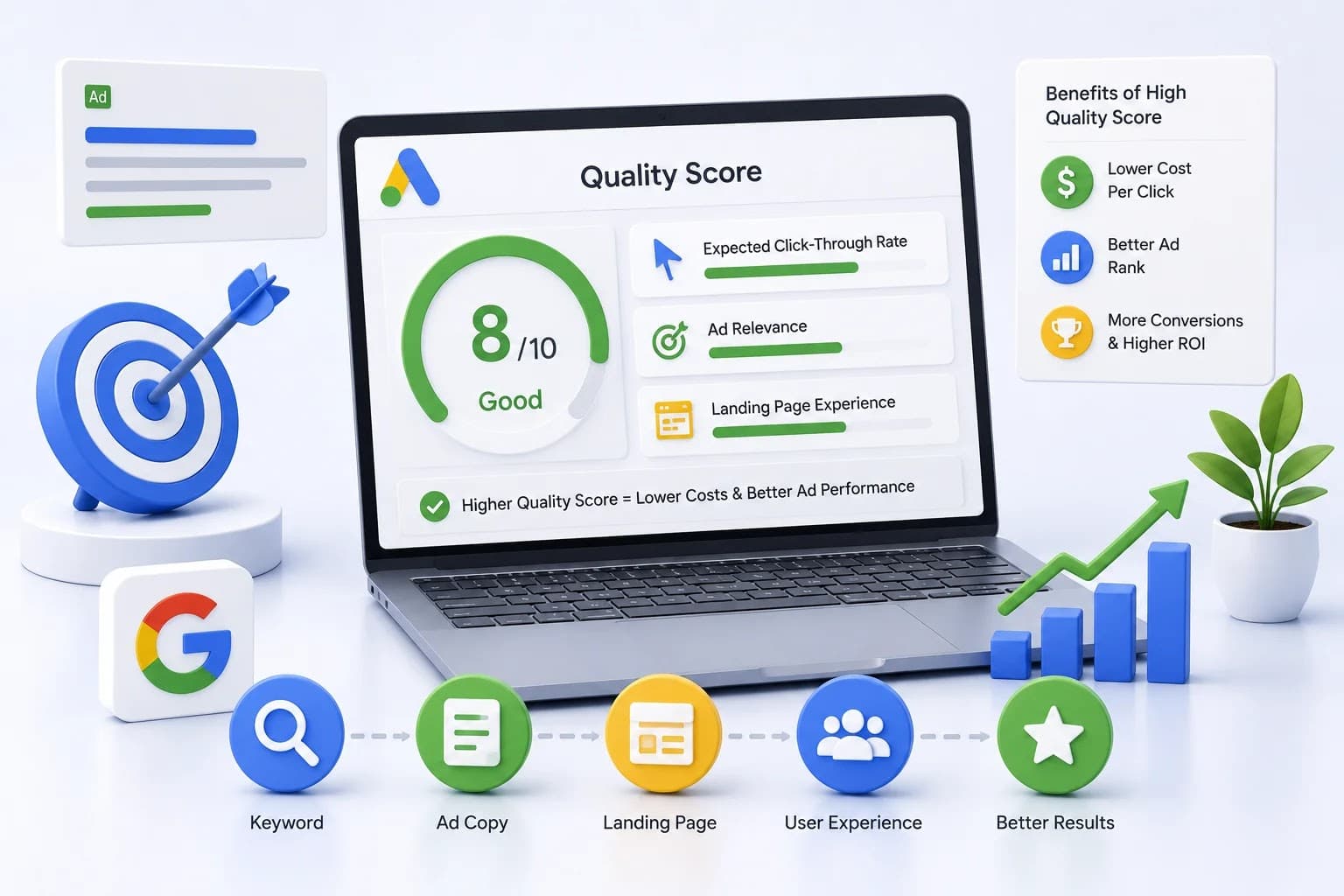
Quality Score is a rating assigned by Google to your keywords based on the quality and relevance of your advertisements, keywords, and landing pages.
The score ranges from:
A higher Quality Score generally means Google considers your ads more useful to users.
Quality Score affects several aspects of your campaign, including:
Improving your Quality Score can help you achieve better results without simply increasing your budget.
Google evaluates each keyword using multiple signals.
The three primary factors are:
Each of these contributes to your overall Quality Score.
Expected CTR estimates how likely users are to click your advertisement when it appears.
Google considers factors such as:
A higher expected CTR indicates that users are likely to find your ad useful.
Ad relevance measures how closely your advertisement matches the user's search query.
Example:
Search:
Digital Marketing Course
Good Ad:
Learn Digital Marketing with Expert Trainers
Poor Ad:
Buy Office Furniture Online
The more relevant your advertisement is to the keyword, the higher your ad relevance score.
After clicking your advertisement, users should arrive on a page that provides the information they expect.
A good landing page should:
A poor landing page can reduce your Quality Score even if your advertisement is excellent.
Google generally categorizes each factor as:
Performing better than competing advertisers.
Performing similarly to competitors.
Needs improvement.
Your goal should be to improve any areas marked "Below Average."
A higher Quality Score can provide:
Rather than simply increasing bids, improving Quality Score can make your advertising budget work more effectively.
Google doesn't rank ads based only on the highest bid.
Ad Rank depends on multiple factors, including:
This means a highly relevant advertisement can outperform one with a larger bid.
Improve your click-through rate by:
Better advertisements attract more clicks over time.
Keep your advertisements closely aligned with your keywords.
For example:
Keyword:
Website Development Company
Headline:
Professional Website Development Services
Description:
Custom business websites designed to grow your online presence.
Relevant messaging improves user experience and Quality Score.
Your landing page should:
Consistency between the advertisement and landing page is essential.
Avoid placing unrelated keywords in the same ad group.
Instead, organize similar keywords together.
Example:
This allows you to create highly relevant advertisements for each topic.
Good advertisements should include:
Example:
Headline:
Learn Google Ads from Industry Experts
Description:
Practical online and offline training with real campaign experience. Enroll today.
Ad assets provide additional information and improve visibility.
Examples include:
Relevant assets can improve the overall effectiveness of your advertisements.
Landing page speed affects user experience.
Improve speed by:
Faster pages encourage users to stay and interact.
Many users click Google Ads on smartphones.
Ensure your landing page:
A strong mobile experience supports higher Quality Scores.
Review campaign metrics such as:
Use these insights to make continuous improvements.
Avoid these mistakes:
Addressing these issues can improve campaign performance over time.
✔ Research relevant keywords
✔ Group similar keywords
✔ Write keyword-focused advertisements
✔ Improve expected CTR
✔ Optimize landing pages
✔ Increase page speed
✔ Improve mobile experience
✔ Add useful ad assets
✔ Monitor campaign performance
✔ Test advertisements regularly
✔ Improve conversion rates
✔ Review Quality Score frequently
Useful tools include:
These tools help identify opportunities to improve both your advertisements and landing pages.
Quality Score | Ad Rank |
Measures keyword quality | Determines ad position |
Scale of 1–10 | Calculated dynamically during each auction |
Based on relevance and user experience | Influenced by bid, Quality Score, ad assets, and search context |
Helps improve campaign efficiency | Decides where your ad appears |
Quality Score is an important contributor to Ad Rank, but it is not the only factor.
Quality Score is Google's rating of the quality and relevance of your keywords, advertisements, and landing pages.
Scores closer to 10 generally indicate stronger relevance and user experience. However, what matters most is continually improving areas marked as below average.
Yes. A higher Quality Score can contribute to lower costs per click and improved ad positions.
Yes. Improve your advertisements, organize keywords effectively, optimize landing pages, and provide a better user experience.
Review Quality Score regularly, especially after making significant changes to your keywords, advertisements, or landing pages.
Google Ads Quality Score is one of the most important indicators of campaign quality. Rather than relying solely on larger advertising budgets, advertisers can improve results by creating relevant advertisements, organizing keywords effectively, and providing excellent landing page experiences.
By focusing on user intent, continuously testing ad copy, improving website performance, and monitoring campaign metrics, you can increase your Quality Score over time. A higher Quality Score not only helps reduce advertising costs but also creates a better experience for users, leading to stronger long-term campaign performance.

Learn what Digital Marketing is, its types, benefits, career opportunities, AI trends, and why it's one of the most in-demand skills for students and professionals in 2026.

Discover the benefits of learning Digital Marketing after college, explore career opportunities, essential skills, freelancing, and how to build a successful Digital Marketing Career.

Explore the top 10 Digital Marketing Skills every student should master, from SEO and Google Ads to AI tools, to build a successful Marketing Skills portfolio and career.