
Loading
 ← Back to blogs
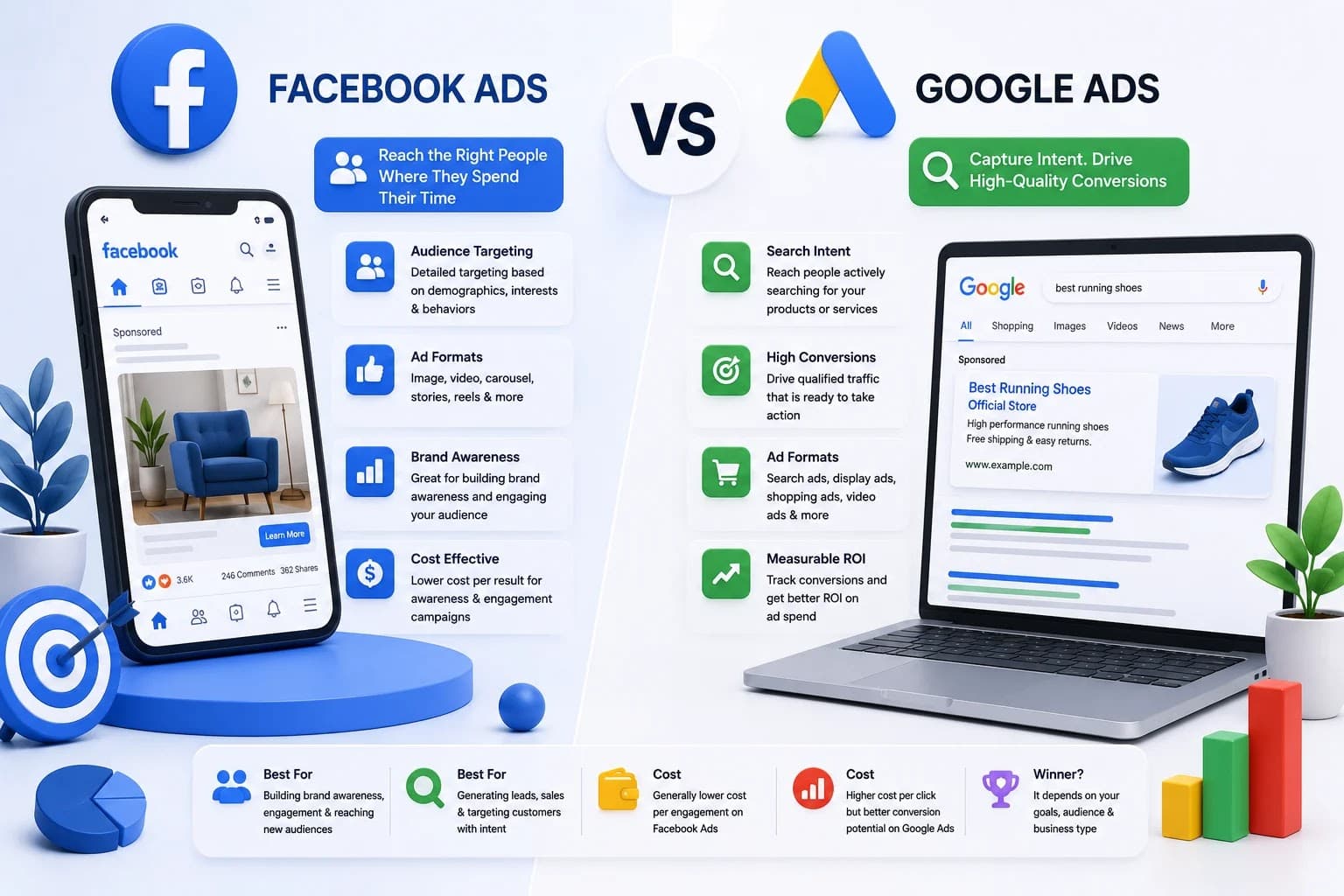
Compare Facebook Ads vs Google Ads, understand their differences, targeting, costs, benefits, and choose the best advertising platform for your business.
Digital advertising has become one of the most effective ways for businesses to reach customers, generate leads, and increase sales. Two of the most popular advertising platforms are Facebook Ads (Meta Ads) and Google Ads.
Although both platforms can help grow a business, they work differently. Google Ads focuses on users who are actively searching for products or services, while Facebook Ads helps businesses reach people based on their interests, behaviors, and demographics.
Choosing the right platform depends on your business goals, target audience, budget, and marketing strategy.
In this guide, we'll compare Facebook Ads and Google Ads to help you decide which platform is best for your business.
Facebook Ads are paid advertisements created through Meta Ads Manager.
Your ads can appear on:
Facebook Ads are designed to reach users based on their interests and online behavior.
Google Ads is Google's online advertising platform.
Your advertisements can appear on:
Google Ads primarily targets users based on their search intent.
The biggest difference is how users are targeted.
Users are targeted based on:
People may not be actively looking for your product when they see your advertisement.
Users are targeted based on:
People are actively searching for a solution.
Facebook Ads | Google Ads |
Interest-based targeting | Search intent targeting |
Appears on Facebook & Instagram | Appears on Google properties |
Strong visual advertising | Strong search advertising |
Excellent for brand awareness | Excellent for lead generation |
Uses audience targeting | Uses keyword targeting |
Great for remarketing | Great for capturing demand |
Facebook's AI analyzes user data to determine who is most likely to engage with your advertisement.
Targeting options include:
This allows businesses to reach highly specific audiences.
Google Ads displays advertisements when users search for relevant keywords.
Example:
A user searches:
Digital Marketing Course
Google may display advertisements from businesses targeting that keyword.
Google determines ad placement using:
Winner: Facebook Ads
Facebook Ads excel at introducing your brand to new audiences through visually engaging advertisements.
Ideal for:
People discover your business while browsing social media.
Winner: Google Ads
Google Ads are highly effective because users are already searching for products or services.
Ideal for:
Search intent often leads to higher-quality inquiries.
Both platforms can be effective.
Excellent for:
Excellent for:
Many online stores use both platforms together.
Advanced targeting includes:
Facebook provides highly detailed audience segmentation.
Targeting options include:
Google excels at reaching users when they are actively searching.
Both platforms support local marketing.
Useful for:
Visual promotions can attract nearby customers.
Useful for:
People often search for these services when they need immediate assistance.
Advertising costs vary depending on:
Generally:
The best value depends on campaign goals and optimization.
Best for:
Best for:
Each platform excels in different targeting scenarios.
Supports:
Strong visual storytelling helps capture attention.
Supports:
Google offers a wide range of campaign formats for different objectives.
Both platforms provide remarketing capabilities.
Reconnect with:
Reconnect with:
Remarketing helps encourage users to return and complete desired actions.
Business Type | Recommended Platform |
Local Service Business | Google Ads |
eCommerce Store | Both |
Digital Marketing Agency | Google Ads |
Fashion Brand | Facebook Ads |
Restaurant | Facebook Ads |
Real Estate | Both |
Coaching Institute | Both |
Healthcare Clinic | Google Ads |
Mobile App | Both |
Personal Brand | Facebook Ads |
For many businesses, the answer is yes.
A combined strategy allows you to:
Using both platforms together often creates a stronger digital marketing strategy.
Avoid these common mistakes:
Continuous optimization is essential on both platforms.
✔ Brand awareness
✔ Product discovery
✔ Social engagement
✔ Visual storytelling
✔ Interest-based targeting
✔ Audience growth
✔ Website leads
✔ Phone calls
✔ Service inquiries
✔ Local customers
✔ Immediate search visibility
✔ High purchase intent
It depends on your goals. Facebook Ads are excellent for brand awareness and audience targeting, while Google Ads are better for reaching users actively searching for products or services.
Costs vary by industry, audience, and competition. Facebook Ads often have lower costs for broad audience reach, while Google Ads may deliver higher-intent traffic for competitive searches.
Both platforms are beginner-friendly. Facebook Ads are often easier for creating visually engaging campaigns, while Google Ads are ideal for businesses targeting search intent.
Yes, if the budget allows. Combining Facebook Ads for awareness with Google Ads for lead generation can create a balanced marketing strategy.
Many eCommerce businesses use both. Facebook Ads help customers discover products, while Google Ads capture users actively searching to buy.
Facebook Ads and Google Ads are both powerful advertising platforms, but they serve different purposes. Facebook Ads help businesses create demand by reaching audiences based on interests and behaviors, making them ideal for brand awareness and visual storytelling. Google Ads captures existing demand by connecting with users who are actively searching for solutions, making it highly effective for lead generation and sales.
Rather than viewing them as competing platforms, many successful businesses use them together. Facebook Ads can introduce your brand to potential customers, while Google Ads helps convert interested users when they begin searching. By understanding the strengths of each platform and aligning them with your marketing objectives, you can build a more effective and sustainable advertising strategy.
SEO Title: Facebook Ads vs Google Ads: Which Advertising Platform is Better for Your Business?
Meta Description (156 characters):
Compare Facebook Ads vs Google Ads, understand their differences, targeting, costs, benefits, and choose the best advertising platform for your business.
Focus Keyword: Facebook Ads vs Google Ads
Secondary Keyword: Meta Ads vs Google Ads
Suggested Image Alt Text:
Facebook Ads vs Google Ads Complete Comparison Guide
Recommended Word Count: 2,800–3,200 words
Link this article to:
This article serves as a key comparison guide within your paid advertising content cluster, helping readers understand when to use Meta Ads, Google Ads, or a combination of both to achieve their marketing goals.
Category: Meta Ads
Focus Keyword: Facebook Ads vs Google Ads
Secondary Keyword: Meta Ads vs Google Ads
Suggested URL: /facebook-ads-vs-google-ads
Reading Time: 12–15 Minutes
Digital advertising has become one of the most effective ways for businesses to reach customers, generate leads, and increase sales. Two of the most popular advertising platforms are Facebook Ads (Meta Ads) and Google Ads.
Although both platforms can help grow a business, they work differently. Google Ads focuses on users who are actively searching for products or services, while Facebook Ads helps businesses reach people based on their interests, behaviors, and demographics.
Choosing the right platform depends on your business goals, target audience, budget, and marketing strategy.
In this guide, we'll compare Facebook Ads and Google Ads to help you decide which platform is best for your business.
Facebook Ads are paid advertisements created through Meta Ads Manager.
Your ads can appear on:
Facebook Ads are designed to reach users based on their interests and online behavior.
Google Ads is Google's online advertising platform.
Your advertisements can appear on:
Google Ads primarily targets users based on their search intent.
The biggest difference is how users are targeted.
Users are targeted based on:
People may not be actively looking for your product when they see your advertisement.
Users are targeted based on:
People are actively searching for a solution.
Facebook Ads | Google Ads |
Interest-based targeting | Search intent targeting |
Appears on Facebook & Instagram | Appears on Google properties |
Strong visual advertising | Strong search advertising |
Excellent for brand awareness | Excellent for lead generation |
Uses audience targeting | Uses keyword targeting |
Great for remarketing | Great for capturing demand |
Facebook's AI analyzes user data to determine who is most likely to engage with your advertisement.
Targeting options include:
This allows businesses to reach highly specific audiences.
Google Ads displays advertisements when users search for relevant keywords.
Example:
A user searches:
Digital Marketing Course
Google may display advertisements from businesses targeting that keyword.
Google determines ad placement using:
Winner: Facebook Ads
Facebook Ads excel at introducing your brand to new audiences through visually engaging advertisements.
Ideal for:
People discover your business while browsing social media.
Winner: Google Ads
Google Ads are highly effective because users are already searching for products or services.
Ideal for:
Search intent often leads to higher-quality inquiries.
Both platforms can be effective.
Excellent for:
Excellent for:
Many online stores use both platforms together.
Advanced targeting includes:
Facebook provides highly detailed audience segmentation.
Targeting options include:
Google excels at reaching users when they are actively searching.
Both platforms support local marketing.
Useful for:
Visual promotions can attract nearby customers.
Useful for:
People often search for these services when they need immediate assistance.
Advertising costs vary depending on:
Generally:
The best value depends on campaign goals and optimization.
Best for:
Best for:
Each platform excels in different targeting scenarios.
Supports:
Strong visual storytelling helps capture attention.
Supports:
Google offers a wide range of campaign formats for different objectives.
Both platforms provide remarketing capabilities.
Reconnect with:
Reconnect with:
Remarketing helps encourage users to return and complete desired actions.
Business Type | Recommended Platform |
Local Service Business | Google Ads |
eCommerce Store | Both |
Digital Marketing Agency | Google Ads |
Fashion Brand | Facebook Ads |
Restaurant | Facebook Ads |
Real Estate | Both |
Coaching Institute | Both |
Healthcare Clinic | Google Ads |
Mobile App | Both |
Personal Brand | Facebook Ads |
For many businesses, the answer is yes.
A combined strategy allows you to:
Using both platforms together often creates a stronger digital marketing strategy.
Avoid these common mistakes:
Continuous optimization is essential on both platforms.
✔ Brand awareness
✔ Product discovery
✔ Social engagement
✔ Visual storytelling
✔ Interest-based targeting
✔ Audience growth
✔ Website leads
✔ Phone calls
✔ Service inquiries
✔ Local customers
✔ Immediate search visibility
✔ High purchase intent
It depends on your goals. Facebook Ads are excellent for brand awareness and audience targeting, while Google Ads are better for reaching users actively searching for products or services.
Costs vary by industry, audience, and competition. Facebook Ads often have lower costs for broad audience reach, while Google Ads may deliver higher-intent traffic for competitive searches.
Both platforms are beginner-friendly. Facebook Ads are often easier for creating visually engaging campaigns, while Google Ads are ideal for businesses targeting search intent.
Yes, if the budget allows. Combining Facebook Ads for awareness with Google Ads for lead generation can create a balanced marketing strategy.
Many eCommerce businesses use both. Facebook Ads help customers discover products, while Google Ads capture users actively searching to buy.
Facebook Ads and Google Ads are both powerful advertising platforms, but they serve different purposes. Facebook Ads help businesses create demand by reaching audiences based on interests and behaviors, making them ideal for brand awareness and visual storytelling. Google Ads captures existing demand by connecting with users who are actively searching for solutions, making it highly effective for lead generation and sales.
Rather than viewing them as competing platforms, many successful businesses use them together. Facebook Ads can introduce your brand to potential customers, while Google Ads helps convert interested users when they begin searching. By understanding the strengths of each platform and aligning them with your marketing objectives, you can build a more effective and sustainable advertising strategy.
Learn what Digital Marketing is, its types, benefits, career opportunities, AI trends, and why it's one of the most in-demand skills for students and professionals in 2026.
Discover the benefits of learning Digital Marketing after college, explore career opportunities, essential skills, freelancing, and how to build a successful Digital Marketing Career.
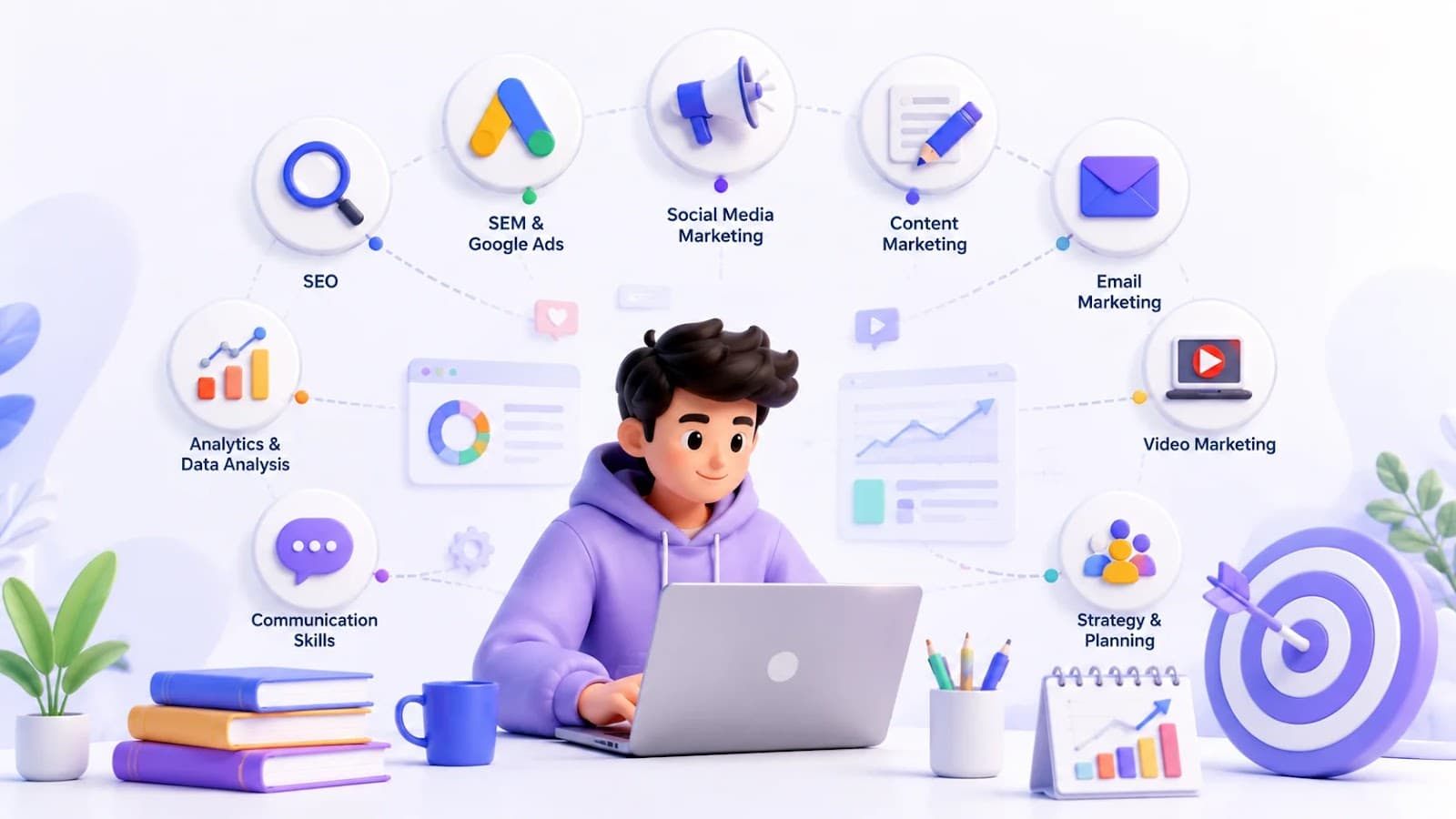
Explore the top 10 Digital Marketing Skills every student should master, from SEO and Google Ads to AI tools, to build a successful Marketing Skills portfolio and career.