
Loading
 ← Back to blogs
Learn email marketing from scratch. Discover email lists, newsletters, automation, segmentation, subject lines, CTAs, metrics, tools, and best practices.
Email marketing is one of the most effective ways for businesses to communicate directly with their audience. From welcoming new subscribers and sharing useful content to promoting products and generating leads, email can support customers throughout their entire journey.
Unlike social media platforms, where businesses depend heavily on algorithms and changing reach, email marketing gives businesses a direct communication channel with people who have chosen to hear from them.
For beginners, email marketing may seem complicated. You may have questions about how to build an email list, what to write, how often to send emails, and how to measure results.
The good news is that the fundamentals are easy to understand.
In this guide, you'll learn what email marketing is, how it works, different types of emails, how to build an email list, how to write effective emails, important metrics, common mistakes, and how to create your first email marketing campaign.
Email marketing is the process of using email to communicate with customers, leads, subscribers, or other audiences.
Businesses use email marketing to:
A typical email marketing campaign starts when someone voluntarily provides their email address and agrees to receive communications.
Email marketing can help businesses communicate with their audience in a direct and measurable way.
Some common benefits include:
For digital marketers, email is particularly useful because it can connect content, lead generation, sales, and customer retention.
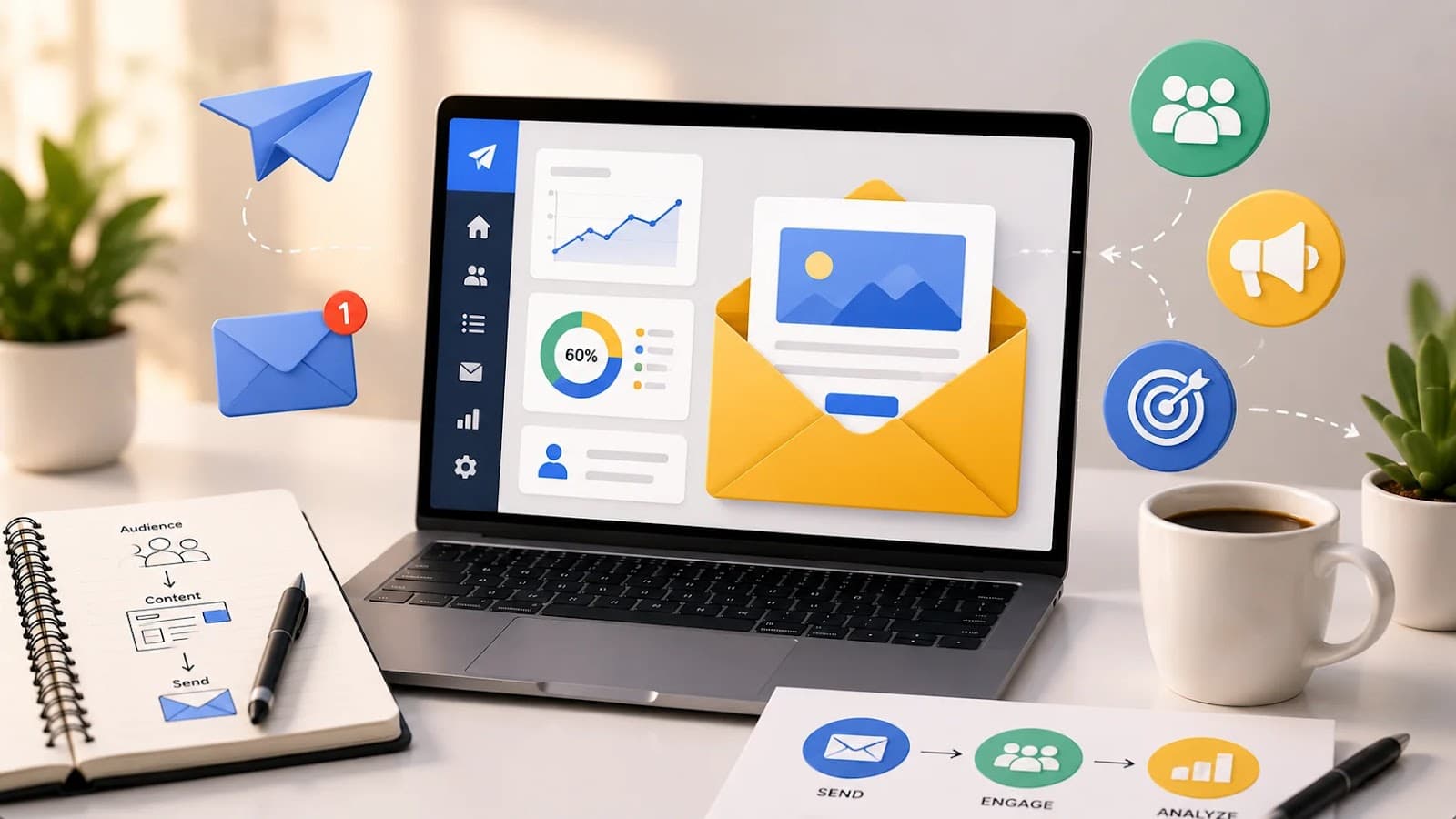
A simple email marketing process looks like this:
Attract Visitors
↓
Collect Email Subscribers
↓
Send Valuable Content
↓
Build Trust
↓
Promote Relevant Products or Services
↓
Track Results
↓
Improve Future Campaigns
The goal isn't simply to send more emails. The goal is to send relevant emails to the right people at the right time.
An email list is a collection of people who have opted in to receive emails from your business.
You can build your list through:
Always collect email addresses through appropriate permission-based methods.
A lead magnet is a useful free resource offered in exchange for contact information, usually an email address.
Examples include:
For example:
Download the Free Digital Marketing Beginner Checklist.
The visitor provides their email address and receives the resource.
Buying email lists may seem like a quick way to gain subscribers, but it can create serious problems.
Purchased lists may contain:
This can hurt email deliverability and damage your sender reputation.
Build your audience organically through valuable content and clear opt-in methods.
There are several common types of marketing emails.
A welcome email is sent after someone subscribes.
It can:
Newsletters are regularly scheduled emails containing useful information.
They may include:
A newsletter helps maintain a relationship with your audience.
Promotional emails are designed to encourage an action such as:
Keep promotional emails focused and relevant to the subscriber.
Educational emails provide useful information without always asking for a purchase.
Examples:
Educational content can build trust and authority.
For eCommerce businesses, abandoned cart emails remind customers about products they added to their cart but didn't purchase.
These emails can encourage users to return and complete their purchase.
Follow-up emails can be used after:
They help continue the conversation with the customer.
Some subscribers stop interacting with emails.
Re-engagement campaigns attempt to reconnect with inactive subscribers.
For example:
Still interested in digital marketing tips?
You can offer useful content or ask whether the subscriber still wants to receive emails.
A good marketing email generally includes:
Keep the message focused on one primary objective.
The subject line is one of the first things subscribers see.
Good subject lines should be:
Examples:
5 SEO Tips Every Beginner Should Know
Your Free Digital Marketing Guide
Learn Google Ads Step by Step
Avoid misleading subject lines simply to increase opens.
Personalization means tailoring email content to the recipient based on available information and appropriate consent.
Examples include:
Personalized communication can make emails more relevant when used appropriately.
Segmentation means dividing your subscribers into groups based on specific characteristics or behavior.
You might segment users by:
For example, an academy could create separate segments for:
Different audiences can receive more relevant content.
Email automation allows emails to be sent automatically based on specific actions or conditions.
Examples include:
New Subscriber
→ Welcome Email
Downloads a Guide
→ Follow-Up Email
Registers for a Course
→ Course Information Email
Makes a Purchase
→ Confirmation Email
Automation helps marketers communicate consistently without manually sending every email.
Email marketing can support different stages of the customer journey.
Introduce your brand and provide useful information.
Share educational content and helpful resources.
Explain your product or service and its benefits.
Encourage the customer to take the desired action.
Continue providing value after the purchase.
A Call-to-Action (CTA) tells the reader what to do next.
Examples:
A good email usually has one clear primary CTA.
You need to measure campaign performance to understand what works.
Important metrics include:
Shows the percentage of delivered emails that were opened, where this measurement is available and meaningful.
Open rates can be affected by privacy features and measurement limitations, so they should not be treated as the only success metric.
Measures the percentage of delivered emails that resulted in clicks on links.
It helps you understand whether your email content and CTA encouraged engagement.
Measures the percentage of recipients who completed a desired action after interacting with your campaign.
Examples:
Shows the proportion of emails that could not be successfully delivered.
A high bounce rate can indicate problems with list quality or email addresses.
Shows how many recipients opted out of your email communications.
A rising unsubscribe rate may indicate that your content, frequency, targeting, or expectations need improvement.
Businesses can use email marketing platforms to manage subscribers and campaigns.
Common features include:
Examples of email marketing platforms include:
Choose a platform based on your audience size, automation requirements, budget, integrations, and business goals.
A professional email should be:
Use:
Avoid filling emails with unnecessary graphics or excessive text.
Many people read emails on mobile devices.
Make sure your emails:
Always preview emails on different screen sizes before sending them.
Follow these principles:
Sending emails too frequently can annoy subscribers.
Subscribers may leave if the content doesn't match their interests.
Clickbait can damage trust and increase complaints.
Poor mobile design can reduce engagement.
Purchased lists can damage deliverability and reputation.
Multiple competing actions can confuse readers.
Choose one main goal for each email.
Broken links, spelling mistakes, and formatting problems can reduce campaign effectiveness.
Always test before sending.
Example:
Generate registrations for a digital marketing webinar.
Example:
College students interested in digital marketing.
Write a clear subject line, useful message, and CTA.
Check:
Send to the appropriate subscriber segment.
Review:
Use the results to improve future campaigns.
Learn:
Learn:
Learn:
Before sending an email, check:
✔ Is the purpose clear?
✔ Is the audience correct?
✔ Is the subject line relevant?
✔ Does the email provide value?
✔ Is the CTA clear?
✔ Are all links working?
✔ Is the email mobile-friendly?
✔ Has the content been proofread?
✔ Are unsubscribe options available?
✔ Are you following applicable email marketing rules?
✔ Have you tested the campaign?
Email marketing is the use of email to communicate with subscribers, customers, and leads for purposes such as education, relationship building, promotions, and sales.
Yes. Email remains an important channel for businesses because it enables direct communication with subscribers and supports lead nurturing, customer retention, and sales.
You can build an email list using website signup forms, landing pages, lead magnets, registrations, webinars, and other permission-based opt-in methods.
There is no universal frequency. Choose a schedule that matches your audience's expectations and the amount of valuable content you can consistently provide.
Email segmentation is the practice of dividing subscribers into groups based on characteristics, interests, behavior, or other relevant criteria so you can send more targeted content.
Yes. Beginners can start with simple automation such as welcome emails, follow-ups, and registration confirmations before moving into more advanced customer journeys.
Email marketing is an essential digital marketing skill because it allows businesses to build direct relationships with their audiences. From welcome emails and newsletters to automated campaigns and promotional messages, email can support customers throughout their journey.
For beginners, the most important thing is not to send as many emails as possible. Focus on building a permission-based audience, providing useful content, sending relevant messages, and measuring meaningful results.
Start with a simple email list, create valuable content, learn basic segmentation and automation, and gradually improve your campaigns using performance data.
Successful email marketing is about delivering the right message to the right person at the right time.

Learn what Digital Marketing is, its types, benefits, career opportunities, AI trends, and why it's one of the most in-demand skills for students and professionals in 2026.

Discover the benefits of learning Digital Marketing after college, explore career opportunities, essential skills, freelancing, and how to build a successful Digital Marketing Career.
Explore the top 10 Digital Marketing Skills every student should master, from SEO and Google Ads to AI tools, to build a successful Marketing Skills portfolio and career.