Loading
 ← Back to blogs
Follow this complete digital marketing learning roadmap to learn SEO, content, social media, Google Ads, analytics, AI, practical projects, and career skills.
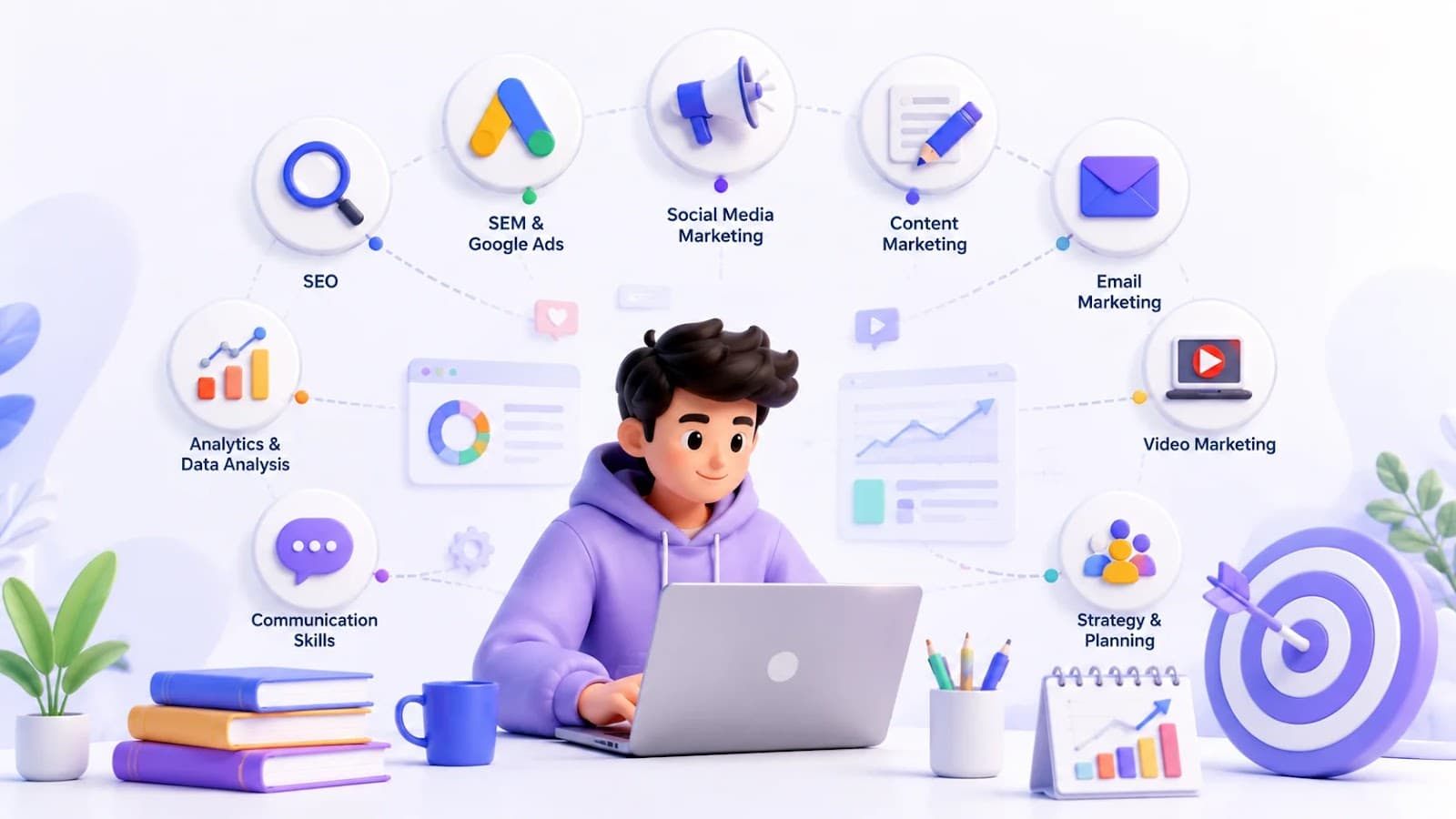
Digital marketing is a broad field that combines marketing strategy, content, search engines, social media, paid advertising, analytics, email marketing, websites, and emerging technologies.
For beginners, this can feel overwhelming.
You may wonder:
The solution is to follow a structured learning path.
You don't need to master everything at once. Start with marketing fundamentals, build your core digital skills, practice with projects, learn analytics, choose a specialization, and gradually develop professional experience.
This complete digital marketing learning roadmap provides a step-by-step path for students, freshers, career switchers, and beginners who want to develop practical digital marketing skills.
Digital marketing is the use of digital channels, platforms, and technologies to promote products, services, brands, or organizations and connect with target audiences.
It can include:
Digital marketing is not simply about posting on social media or running advertisements.
It involves understanding customers, channels, content, data, and business objectives.
Without a structured plan, beginners often jump from one topic to another.
They may learn:
SEO → Canva → Google Ads → Instagram → Email → AI → SEO again
without developing a strong foundation.
A roadmap helps you learn in the right sequence.
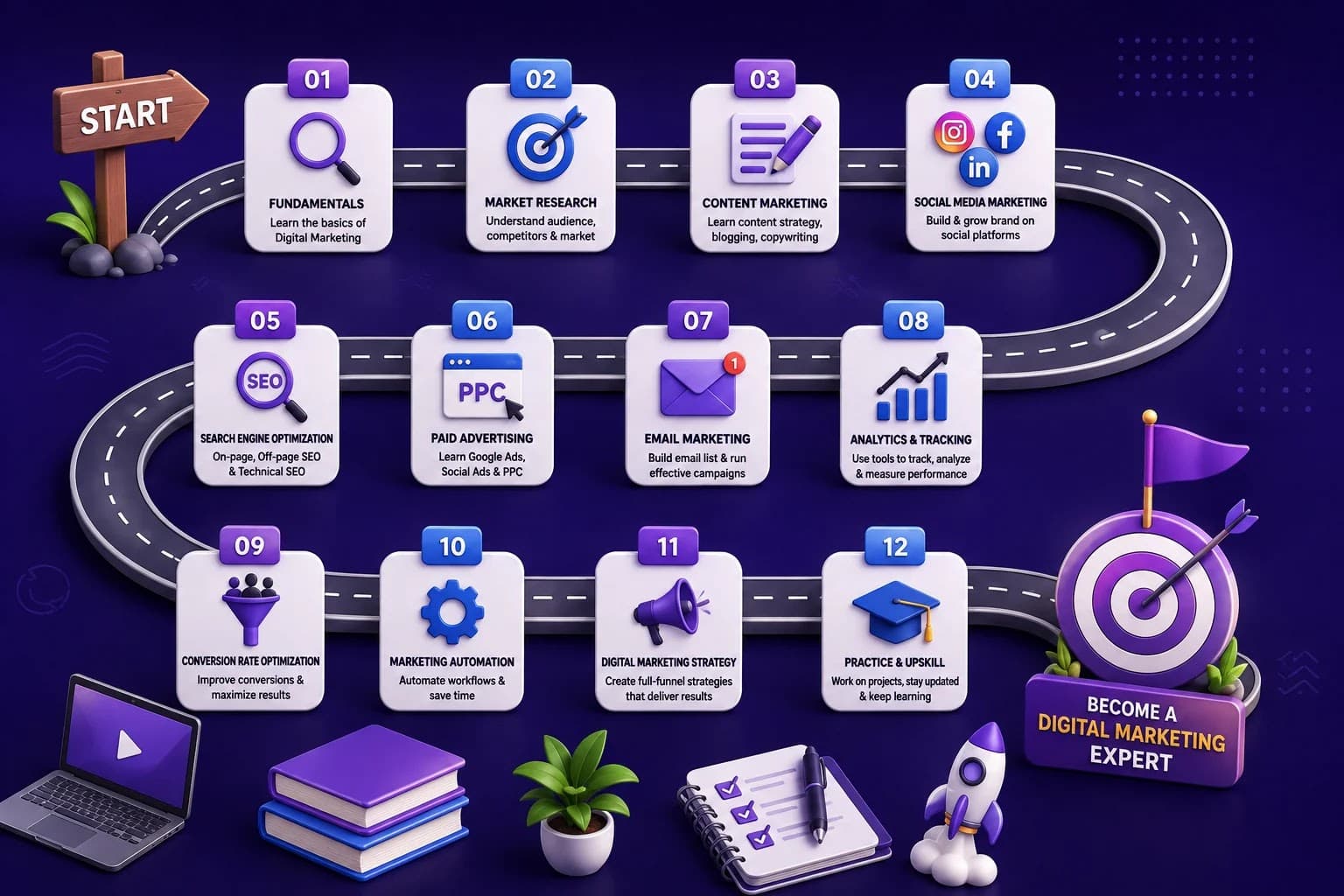
The basic progression is:
Marketing Fundamentals
↓
Website Fundamentals
↓
SEO
↓
Content Marketing
↓
Social Media Marketing
↓
Paid Advertising
↓
Email Marketing
↓
Analytics
↓
Conversion Optimization
↓
AI & Automation
↓
Practical Projects
↓
Portfolio
↓
Specialization
↓
Professional Experience
You can adjust the pace depending on your available time and career goals.
Before learning individual platforms, understand the fundamentals of marketing.
This is the foundation of your entire digital marketing career.
Learn about:
A basic marketing funnel can be understood as:
Awareness
↓
Interest
↓
Consideration
↓
Conversion
↓
Retention
For example, someone may:
Understanding this journey helps you decide which marketing channel and message should be used at each stage.
A marketer needs to understand who they are trying to reach.
Study:
Ask:
Who is the customer?
What problem are they trying to solve?
Why would they choose this product or service?
These questions are more important than simply knowing how to operate a marketing tool.
A website is often the center of a digital marketing strategy.
You don't need to become a professional developer, but you should understand how websites work.
Learn:
Also understand the difference between:
This knowledge will help you with SEO, advertising, analytics, and conversion optimization.
SEO should be an important part of your digital marketing learning roadmap.
SEO helps websites improve their visibility in search engine results.
Start with the basics.
Keyword research helps identify the terms people use when searching for information, products, or services.
Learn:
Practice creating keyword lists for different industries.
For example:
Education
Healthcare
The goal isn't simply to find keywords with high search volume.
You need to understand search intent and business relevance.
Understand how to optimize individual web pages.
Learn:
Practice optimizing a sample blog post.
Technical SEO focuses on how search engines crawl, understand, and access websites.
Learn about:
You don't need to become a developer, but you should understand what these concepts mean and how they can affect SEO.
Off-page SEO includes activities that help build a website's authority and visibility outside its own pages.
Learn:
Focus on understanding quality and relevance rather than simply trying to collect as many links as possible.
Content marketing helps businesses attract, educate, and engage audiences.
Learn how to create a content strategy based on:
Content can include:
Develop skills in:
Practice writing different types of content.
For example:
Blog article: Educates the audience.
Product description: Explains a product.
Landing page: Encourages an action.
Social media caption: Captures attention and encourages engagement.
Each format has a different purpose.
Social media is an important digital marketing channel.
Learn:
Major platforms include:
Don't try to master every platform immediately.
Start with one or two platforms that are relevant to your target audience.
A social media strategy should answer:
Who are we targeting?
What content will we publish?
Why will people care?
What action do we want users to take?
Create content categories such as:
Then build a content calendar.
Once you understand basic marketing concepts, start learning paid advertising.
Paid marketing allows businesses to reach targeted audiences through advertising platforms.
Important platforms include:
Learn:
Start with the fundamentals.
Understand:
Don't just learn where to click inside the platform.
Understand the strategy behind campaign decisions.
Learn:
Practice creating sample campaign structures.
Email marketing is useful for nurturing leads, communicating with customers, and encouraging repeat purchases.
Learn:
Understand different email types:
Analytics is one of the most important skills for a digital marketer.
Marketing isn't only about creating content or running campaigns.
You need to understand the results.
Learn how to measure:
Learn the fundamentals of Google Analytics and understand concepts such as:
Practice interpreting reports.
Don't simply memorize metric definitions.
Ask:
What does this data tell me?
What should I do next?
Search Console is particularly useful for SEO.
Learn how to analyze:
Use this data to identify content and SEO opportunities.
Driving traffic is only one part of marketing.
You also need to understand what happens after someone visits your website.
Learn about:
For example:
If 10,000 people visit a website but only 20 people submit a form, increasing traffic may not be the first priority.
You may need to improve the conversion experience.
Different channels have different metrics.
The important skill is knowing which metrics matter for the business objective.
AI tools can support many marketing workflows.
Learn how AI can assist with:
Popular AI tools may include:
However, don't depend entirely on AI.
Learn how to:
AI should improve your workflow, not replace your marketing thinking.
Digital marketers frequently work with visual content.
You don't need to become a professional designer.
Learn basic principles such as:
Tools such as Canva can help you create:
Video has become an important format across digital platforms.
Learn:
Practice creating simple marketing videos.
As your skills improve, learn how automation can reduce repetitive tasks.
Automation can support:
The goal is to understand where automation can improve efficiency while maintaining a good customer experience.
This is where your learning becomes practical.
Don't wait until you get a job to start building projects.
Create your own.
Choose a website and analyze:
Create a report with recommendations.
Choose an industry.
Research:
Organize everything in a spreadsheet.
Create a 30-day content plan.
Include:
Create a sample campaign.
Include:
Clearly label it as a practice project.
Create a sample campaign structure.
Include:
Use available sample or personal website data and create a marketing report.
Explain:
This demonstrates analytical thinking.
A portfolio is extremely important for students and freshers.
Include your strongest projects.
Your portfolio can contain:
For every project, explain:
Problem
↓
Research
↓
Strategy
↓
Execution
↓
Result / Expected Outcome
↓
Learning
Don't invent results.
If it's a practice project, clearly state that.
Certifications can support your learning.
Consider relevant certifications in:
Don't collect certificates simply to make your resume longer.
Choose certifications that match your career goal.
The ideal combination is:
Certification + Project + Portfolio
After learning the fundamentals, choose an area to specialize in.
Focus on:
Focus on:
Focus on:
Focus on:
Focus on:
Focus on:
Digital marketing isn't only about traffic and engagement.
Businesses care about:
Learn to connect marketing activities with business objectives.
For example:
SEO
→ Organic traffic
→ Leads
→ Customers
→ Revenue
Understanding this connection makes your marketing work more valuable.
Digital marketers work with many people.
Develop your ability to:
A marketer who can explain complex information simply has a major advantage.
Once you have foundational knowledge, look for practical opportunities.
Consider:
Real-world experience teaches you how to handle:
As you learn, share your knowledge online.
You can publish:
This can help demonstrate your knowledge to potential employers and clients.
If you're starting from zero, here's a practical example.
Learn:
Build:
Learn:
Build:
Learn:
Build:
Learn:
Build:
Learn:
Build:
Choose a specialization.
Improve your strongest projects.
Build your portfolio.
Start applying for:
This timeline is flexible. You can move faster or slower depending on your available time and learning pace.
If six months feels too long, start with 90 days.
Focus on:
Create:
Focus on:
Create:
Focus on:
Create:
Then start applying for internships and entry-level opportunities.
You don't need to study for eight hours every day.
A consistent routine is more useful.
Learn a concept.
Watch or read practical examples.
Apply the concept.
Work on a project.
That gives you 2 hours of focused learning and practice.
If you have less time, even 30–60 minutes of consistent practice can help.
Don't measure progress only by the number of courses completed.
Ask:
Can I explain the basic concept?
Can I use the tool?
Can I analyze the results?
Can I develop a strategy and explain why I chose it?
Can I solve complex marketing problems and improve results consistently?
Your goal should be to move from knowledge → application → analysis → strategy.
Digital marketing is huge.
Build a foundation and specialize later.
Watching videos isn't the same as practicing.
Certificates are useful, but projects demonstrate practical skills.
Learn to measure what you're doing.
Digital marketing includes much more than social media.
Marketing should contribute to meaningful business outcomes.
Understand the reasoning behind a strategy.
Some marketing activities take time.
Document your projects as you learn.
Learning doesn't end when the course ends.
Use this checklist to track your progress.
The fundamentals can be learned progressively over several months. Becoming highly skilled requires continuous practice, real-world projects, and professional experience.
Yes. You can learn digital marketing through courses, certifications, practical projects, internships, freelancing, and self-directed learning.
Start with marketing fundamentals, target audiences, customer journeys, websites, and basic digital marketing concepts before specializing.
Both are valuable. SEO helps you understand organic search and content visibility, while Google Ads teaches paid acquisition and campaign management. Learn the fundamentals of both before choosing a specialization.
You don't need to become a professional programmer. However, understanding basic HTML, CSS, website structure, and technical concepts can be very useful, particularly for SEO and website optimization.
Certifications aren't always required. They can demonstrate structured learning, but practical skills, projects, portfolios, and experience are also important.
There isn't one universally best skill. SEO, performance marketing, content, social media, analytics, and email marketing can all lead to different career paths.
Yes. Students can start with fundamentals, build practice projects, complete relevant certifications, and develop a portfolio before applying for internships or entry-level roles.
Yes. Many high-quality educational resources are available online. The important thing is to combine learning with practical application.
Learning digital marketing doesn't require you to master every tool at once.
Start with the fundamentals.
Understand your audience.
Learn how websites work.
Develop SEO and content skills.
Understand social media and paid advertising.
Learn analytics.
Explore AI and automation.
Then build projects, create a portfolio, choose a specialization, and gain real-world experience.
The most effective learning process is:
Learn → Practice → Build → Measure → Improve → Repeat
Don't measure your progress by how many courses you've completed.
Measure it by what you can actually create, analyze, explain, and improve.
If you're a student or fresher, start small. Build one project at a time. Document your work. Learn from mistakes. Gradually develop deeper expertise in the area you enjoy most.
Digital marketing is a continuously evolving field, so the goal isn't to finish learning.
The goal is to become a marketer who can understand people, use digital channels effectively, analyze data, solve problems, and contribute to business growth.
Learn what Digital Marketing is, its types, benefits, career opportunities, AI trends, and why it's one of the most in-demand skills for students and professionals in 2026.
Discover the benefits of learning Digital Marketing after college, explore career opportunities, essential skills, freelancing, and how to build a successful Digital Marketing Career.
Explore the top 10 Digital Marketing Skills every student should master, from SEO and Google Ads to AI tools, to build a successful Marketing Skills portfolio and career.