
Loading
 ← Back to blogs
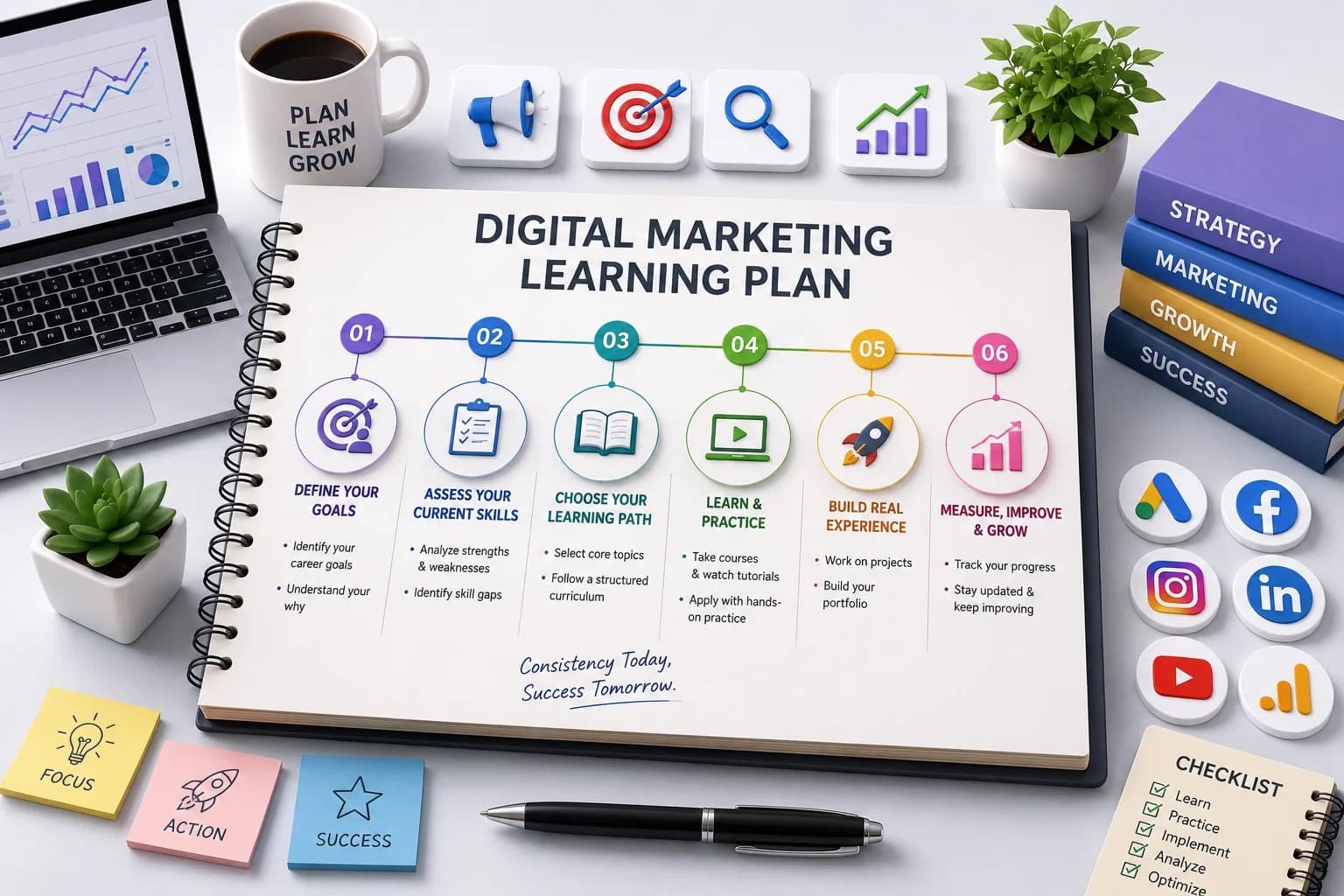
Build a practical digital marketing learning plan for 2026. Step-by-step roadmap, skills order, 90-day schedule, free tools & common mistakes to avoid.
Most people who want to learn digital marketing start by watching random YouTube videos or buying the first course they see. Three weeks later they feel overwhelmed, jump to another platform, and still cannot explain what they actually know.
A proper digital marketing learning plan stops that cycle. It tells you exactly what to learn first, how to practise it, and how to measure progress. This guide gives you a realistic, step-by-step plan you can start using this week.
Digital marketing has too many channels. SEO, Google Ads, Meta Ads, email, content, analytics, AI tools — the list keeps growing. Without a plan, beginners usually do three things wrong:
A clear plan forces focus. You build one skill, apply it on a real project, then move to the next. That sequence creates actual competence instead of surface knowledge.
Common Mistake
Jumping between SEO tutorials, ads courses and freelancing advice in the same week. The brain never gets enough repetition to turn information into skill.
Before choosing topics, answer one question: What do you want digital marketing to do for you in the next 6–12 months?
Possible goals:
Your goal changes the order of skills. Someone who wants a job needs stronger analytics and campaign reporting skills. A freelancer needs client communication and basic proposal writing alongside the technical skills. A business owner needs channels that can bring leads quickly.
Write your goal in one sentence and keep it visible while you study.
Learning digital marketing works best when skills build on each other. Here is a practical sequence that works for most beginners in 2026:
Why this order?
You cannot run effective ads if you do not understand how people search or how a website converts. You cannot improve campaigns if you cannot read the data. Starting with foundations and measurement prevents expensive mistakes later.
Expert Tip
Create a simple free website (WordPress.com or Google Sites is enough) in the first two weeks. Applying every new skill on that site teaches faster than any tutorial.
Here is a realistic timeline that balances learning and practice.
Phase | Duration | Focus Areas | Weekly Time | Output |
Foundation | Days 1–21 | Marketing basics, website, Analytics, Search Console | 10–12 hrs | Live website + tracking set up |
Organic Growth | Days 22–50 | Keyword research, on-page SEO, content writing, basic social | 12–15 hrs | 4–5 blog posts + social profiles |
Paid & Conversion | Days 51–75 | Google Ads, Meta Ads, landing pages, email | 12–15 hrs | Small test campaigns + email sequence |
Advanced & Portfolio | Days 76–90 | AI tools, reporting, case study, freelancing basics | 10–12 hrs | Portfolio piece + simple report |
This is not a rigid calendar. Adjust based on your available hours. The important part is finishing one phase before starting the next.
Instead of random study sessions, follow this simple weekly rhythm:
Study theory (2–3 hours)
↓
Apply on your own site or project (4–5 hours)
↓
Review results & notes (1–2 hours)
↓
Adjust next week’s focus
This loop is more effective than binge-watching videos.
Focus on understanding how digital marketing actually works.
Practical Example
Create a simple “About” page and a contact form. Then set up GA4 so you can see when someone visits that page. This single exercise teaches tracking better than any theory.
Quick Checklist – Foundations
✓ Website live
✓ GA4 installed and receiving data
✓ Search Console verified
✓ One clear goal written down
Many beginners skip keyword research and start writing random blog posts. Those posts get almost no traffic because they do not match what people actually search for.
Better approach:
Pro Tip
Write one solid blog post every week for four weeks. Publish it, submit the sitemap, and track rankings in Search Console. This single habit builds more SEO understanding than twenty theoretical videos.
Common Mistake
Obsessing over keyword difficulty scores while ignoring search intent. A lower-difficulty keyword with clear commercial intent often converts better than a high-volume informational one.
Start small. Use ₹500–1000 test budgets.
Learn in this order:
Run one Google Search campaign and one Meta traffic or lead campaign. Keep them running for at least 7–10 days so you can see real data.
Build a basic email sequence (welcome + 2–3 value emails). Then explore AI tools for research, content outlines and ad copy variations — always edit the output yourself.
Finally, turn your 90 days of work into a simple case study: “I grew organic traffic from 0 to X” or “I generated Y leads with a ₹2000 budget.”
You do not need expensive software at the beginning.
Skill | Free / Low-Cost Tool |
Website | WordPress.com / Google Sites |
Analytics | Google Analytics 4 + Search Console |
Keyword Research | Google Keyword Planner + free Ahrefs/SEMrush limited tools |
Design | Canva |
Mailchimp free plan | |
Ads | Google Ads & Meta Ads (with small budget) |
Reporting | Google Looker Studio |
Master these before paying for premium tools.
Waiting for real clients is the slowest way to learn. Create your own practice projects:
These projects become portfolio pieces.
With consistent 12–15 hours per week:
People who only watch courses without applying skills often take twice as long.
Stop measuring “hours studied.” Track these instead:
If you can clearly explain what you did and why it worked (or failed), you are progressing.
Self-study works for motivated people who already have discipline. Many beginners, however, benefit from a guided path with feedback, live doubt sessions and accountability. If you prefer structure over pure self-learning, a well-designed Digital Marketing Course can compress the trial-and-error phase significantly.
Use this to begin immediately:
✓ Write your 6-month goal in one sentence
✓ Create a free website
✓ Install GA4 and Search Console
✓ Choose one niche or practice topic
✓ Research 10 keywords and note search intent
✓ Publish your first simple page or post
✓ Set a weekly study + practice schedule
A digital marketing learning plan is only useful if you follow it. Start with the foundations, apply every skill on a real project, and review your results every week. That simple loop turns beginners into competent marketers faster than any scattered approach.
The plan above is realistic for 2026. Adjust the pace to your life, but do not skip the practice steps. Application is what separates people who “know about digital marketing” from people who can actually do it.
A digital marketing learning plan only works when you treat it as a practical roadmap, not a reading list. Start with a clear goal, follow a logical skill order, apply every concept on a real project, and measure progress by results instead of hours spent.
The 90-day structure shared above is designed for busy beginners — students, fresh graduates, career switchers and small business owners. You do not need to master every channel at once. Focus on foundations first, build one live project, then expand.
Consistency matters more than speed. Even 10–12 focused hours per week, repeated for three months, produces visible skills and portfolio pieces. Skip the random video hopping. Follow the sequence, practise deliberately, and review your numbers every week.
Begin this week with the 7-day starter checklist. Your future self will thank you for the structure you create today.
1. How long does it take to create and complete a digital marketing learning plan?
A solid plan can be written in one sitting. Completing the first 90 days of structured learning and practice usually takes 3–4 months with 12–15 hours per week. Job or freelance readiness typically takes 5–7 months of consistent application.
2. Can I learn digital marketing without any prior experience or degree?
Yes. Most working digital marketers did not study marketing in college. What matters is practical skill, a simple portfolio, and the ability to explain results. A degree is rarely required for entry-level roles or freelance work.
3. Should I learn everything at once or focus on one skill?
Focus on one major skill area at a time. Trying to learn SEO, ads, email and social media together usually leads to shallow knowledge and quick burnout. Follow the skill order in this guide.
4. Is free learning enough or do I need a paid course?
Free resources are excellent for theory. The gap appears in application, feedback and accountability. Many beginners progress faster with a structured course that includes live guidance and project reviews, especially if self-discipline is a challenge.
5. How much money do I need to start practising?
You can begin with almost zero cost using free tools. For paid ads practice, keep test budgets small — ₹500 to ₹2000 is enough to run meaningful experiments and learn from real data.
6. What if I am working full-time or studying?
Reduce the weekly hours to 8–10 and stretch the 90-day plan to 4–5 months. Protect consistency over intensity. Even one focused practice session every weekday evening compounds quickly.
7. How do I know my learning plan is working?
You will see clear signals: a live website with tracking, published content that ranks or gets traffic, small campaigns that generated data, and the ability to explain what you did and why. If you only have notes and no live results after 60–90 days, adjust the plan toward more application.

Learn what Digital Marketing is, its types, benefits, career opportunities, AI trends, and why it's one of the most in-demand skills for students and professionals in 2026.

Discover the benefits of learning Digital Marketing after college, explore career opportunities, essential skills, freelancing, and how to build a successful Digital Marketing Career.
Explore the top 10 Digital Marketing Skills every student should master, from SEO and Google Ads to AI tools, to build a successful Marketing Skills portfolio and career.